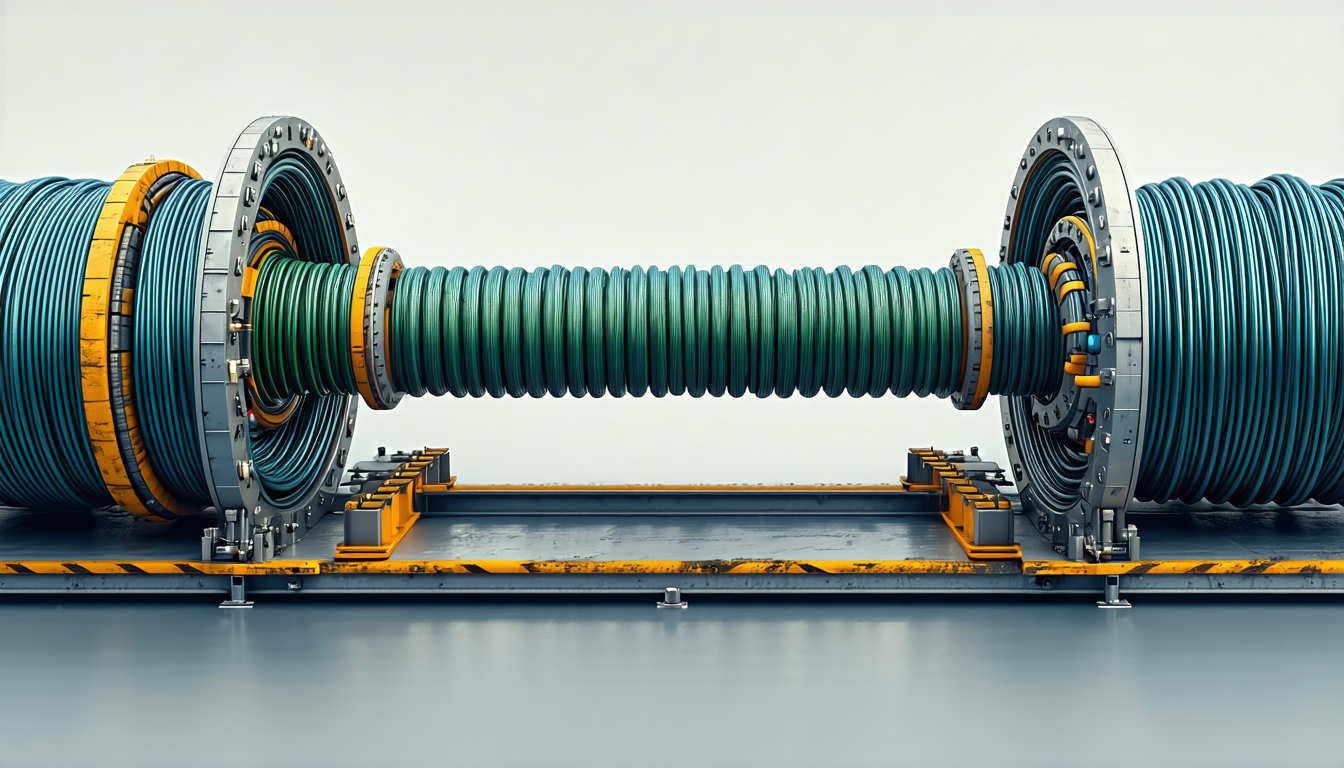
Meta reaches a petabit at 7,000 km by doubling the cores inside a 125-micron fiber
Petal keeps Anjana's 24 fiber pairs and puts two cores in every fiber, so throughput per pair stays near 20.8 Tbps and each of roughly a hundred repeaters has to amplify 96 cores in one body.
The Engineer · Build desk
What happened
- Meta's Petal cable will run about 7,000 km between France and the United States at 1 Pbps, which the company says is double what the most advanced subsea cables carry at that distance.
- Each repeater is a single body holding 96 amps, with a Fan-In/Fan-Out interface splitting every 2-core fiber into two single-core fibers for amplification and recombining them afterwards.
- Meta is building Petal with NEC and Sumitomo Electric Industries, with Orange supporting the landing in France, for service in 2029.
Why it matters
- What's now possible capability Double the transatlantic capacity now fits behind one cable and one set of landings, so the next petabit of transatlantic supply arrives without a second wet plant to build, permit and repair.
- What it limits constraint Capacity growth is coming from core count, so a 2030s capacity model should be sized against repeater bodies and amplifier counts.
- What it costs cost Ninety-six amps in one body across about a hundred repeaters is roughly 9,600 amplifiers to power and cool, and Meta's claim is that power rises less than proportionally, not that it stays flat.
- Who has to decide decision Anyone specifying a post-2029 cable now has a third option to price against going to 48 fiber pairs or opening the L band, and it comes with a FIFO repeater in the wet plant.
Next story · Product · 2h ago
Meta says it fixed Ray-Ban glasses that recorded conversations without the wake phraseConfirmed4 publishers
Meta specifies Petal at 1 Pbps, or 1,000 Tbps [5], across what it describes as a 24 fiber-pair system built on 2-core fiber and equivalent to 48 fiber pairs [6]. That is about 20.8 Tbps per equivalent pair [18]. Anjana, Meta's 24-pair transatlantic system, was the first at 0.5 Pbps [10], which is also about 20.8 Tbps per pair [19]. Throughput per pair stays put [20].
Meta also renders the figure as roughly the capacity for 75% of the world's population to stream music at the same time, with an asterisk [7].
Meta's own history explains why the gain has to be spatial. Coherent transmission and dispersion-uncompensated cable designs bought 10x and more per fiber through the 2010s until the Shannon Limit pushed back [8], and the industry answered by putting more fibers in the cable [9]: Marea's eight pairs, Amitie's 16, Anjana's 24 [10]. Petal holds the pair count and adds cores.
Three candidates were on the table, according to the post: go to 48 fiber pairs, open the L-band for 24-pair C+L transmission as on the PLCN cable, or adopt 2-core fiber [17]. Meta took the third [6].
Outer diameter is the constraint that forces the hard engineering. A 2-core fiber here has to hold 125 micron width and low attenuation at the same time, and the cores must not talk to each other [12]. Meta says the first comes from ultra-pure synthetic silica in the preform, and the second from a high refractive index in each core against a lower index in the surrounding medium, plus counter-propagating the optical signals, which leaves crosstalk "nearly immeasurable" [13]. Counter-propagation is also a direction assignment: the two cores of a fiber have to run in opposite directions.
The repeater is where the doubling turns into hardware. A 7,000 km cable typically needs about a hundred repeaters [14], roughly one every 70 km [22]. Petal's is a single body with 96 amps [15], which is 24 pairs times two fibers times two cores [21]. Amplification is still single-core: a Fan-In/Fan-Out interface splits each 2-core fiber into two single-core fibers inside the repeater, amplifies them, then recombines them into 2-core fiber [15]. Over the full route that is on the order of 9,600 amplifiers [23].
Meta's phrasing is that multi-core fiber doubles capacity per fiber "without a proportional increase in power or physical infrastructure" [3]. Proportional. Ninety-six amplifiers in one body draw more than 48, and Meta did not publish a power budget for the wet plant. The saving it does quantify in kind is the cable count: two 0.5 Pbps systems become one petabit system, which Meta says cuts materials, resources and carbon footprint [11].
For the 1 Pbps number to transfer to another route, the route needs this fiber, this repeater, and roughly the same 7,000 km span [1]. Petal is expected in service in 2029, built with NEC and Sumitomo Electric Industries, with Orange supporting the French landing [2][4].
What to watch
- Whether Meta publishes a wet-plant power figure for the 96-amp single-body repeater, which is the only way to test the power claim.
- Whether NEC and Sumitomo Electric Industries sell 2-core fiber and FIFO repeaters to other cable buyers before Petal enters service in 2029.
- Whether a later system combines 2-core fiber with C+L band transmission, stacking the two options Meta weighed separately.
Clarity's read
What the record supports and how the coverage leans. The claims behind it follow.
Reality
- Evidence45
- Adoption5
- Hype gap+20
- Incentives70
- Confidence60
Perspective Coverage
3 publishers- Builder
- Builder 42%
- Operator
- Operator 28%
- Investor
- Investor 30%
Claim ledger
Ranked by verification strength, evidence, and original report placement.
- [1]
Petal will be the first subsea cable to deliver petabit capacity at transoceanic distances, connecting France and the United States over approximately 7,000 km (4,300 mi).
- [2]
Petal is expected to enter service in 2029.
- [3]
Petal will be the first subsea cable system to deploy multi-core fiber technology at scale, doubling the capacity per fiber without a proportional increase in power or physical infrastructure.
- [4]
Petal will be built in partnership with NEC and Sumitomo Electric Industries, with support on the French landing from Orange.
- [5]
Petal will deliver 1 Pbps (1 petabit per second, or 1,000 terabits per second), doubling what today's most advanced subsea cables carry at this distance.
- [6]
Petal uses 2-core fiber technology in a 24 fiber-pair system, equivalent to 48 fiber pairs, which Meta says is double Anjana's capacity and the single largest generational increase in cable capacity of any repeatered subsea system ever.
- [7]
Meta says 1 Pbps is roughly the network capacity required for 75% of the world's population to stream music at the same time, marking the comparison with a footnote asterisk.
- [8]
In the 2010s, coherent optical transmission technology and dispersion-uncompensated cable designs produced fiber capacity increases of 10x and more until the Shannon Limit pushed back.
- [9]
The industry pivoted to spatial division multiplexing (SDM) to increase the number of fibers within a subsea cable.
- [10]
Meta scaled its subsea approach from Marea's eight fiber pairs, to Amitie's 16 fiber pairs, to Anjana's 24 fiber pairs, the first 0.5 Pbps transatlantic cable system.
- [11]
Meta says carrying a petabit through one cable significantly reduces materials, resources and carbon footprint compared to building two 0.5 Pbps systems.
- [12]
The two main challenges in enabling 2-core fiber for Petal are ensuring low attenuation while maintaining the physical dimensions of the outer fiber, including the 125 micron width, and minimizing crosstalk between the cores.
- [13]
Low attenuation is achieved using ultra-pure synthetic silica during manufacture of the preform; crosstalk is minimized by controlling for high refractive indexes in the cores against lower indexes in the surrounding medium and counter-propagating the optical signals, resulting in nearly immeasurable crosstalk.
- [14]
A 7,000 km subsea cable typically needs about a hundred repeaters to amplify the signals along the length of the cable.
- [15]
Petal's single-body 96 amp repeater uses single-core fiber amplification with a Fan-In/Fan-Out (FIFO) interface to transition 2-core fiber into two single-core fibers within each repeater and then back to 2-core fiber following amplification.
- [16]
Approximately 99% of intercontinental data traffic travels through glass strands on the ocean floor.
- [17]
Meta identified three innovations that could double capacity again: continuing the conventional path to 48 fiber pairs, expanding the optical transmission band by using the L-band as on the PLCN cable for 24 fiber pair C+L transmission, or adopting a 2-core fiber-based solution.
- [18]
Petal's capacity works out to about 20.8 Tbps per equivalent fiber pair.
- [19]
Anjana's capacity works out to about 20.8 Tbps per fiber pair.
- [20]
Throughput per fiber pair is unchanged between Anjana and Petal at about 20.8 Tbps, so Petal's doubling comes entirely from doubling the cores per fiber rather than from more bits per core.
- [21]
Petal's 96 amplified cores per repeater equal 24 fiber pairs times two fibers per pair times two cores per fiber.
- [22]
About a hundred repeaters over 7,000 km is roughly one repeater every 70 km.
- [23]
Petal's full route carries on the order of 9,600 optical amplifiers.
Sources
2 independent publishers whose own reporting we read for this story.
- engineering.fb.comInside Petal: Building the World’s First Petabit-Class Transoceanic Subsea Cable
1 article · September 21, 2026
- fortune.comMeta is building one of the world’s biggest undersea cable networks—it’s just one piece of a growing seafloor empire spanning 6 continents
1 article · October 3, 2026
- runtimewire.comMeta plans a 1 Pbps transatlantic cable using two-core fiber
1 article · September 21, 2026
Topics and entities
Topics
- Spatial Division Multiplexing
- Subsea Cables
- Hyperscaler network infrastructure
- Multi-Core Fiber
Entities
- Sumitomo Electric Industries
- Project Waterworth
- Meta