Filmed live without oxygen, Asgard archaea crawl on protrusions that actin inhibitors stop
University of Vienna researchers filmed two Asgard archaea strains crawling on protrusions, a motion previously known only in eukaryotic cells. The team argues that such motility may predate complex cells, a timing claim that so far rests on two lab strains.
The Scientist · Science desk
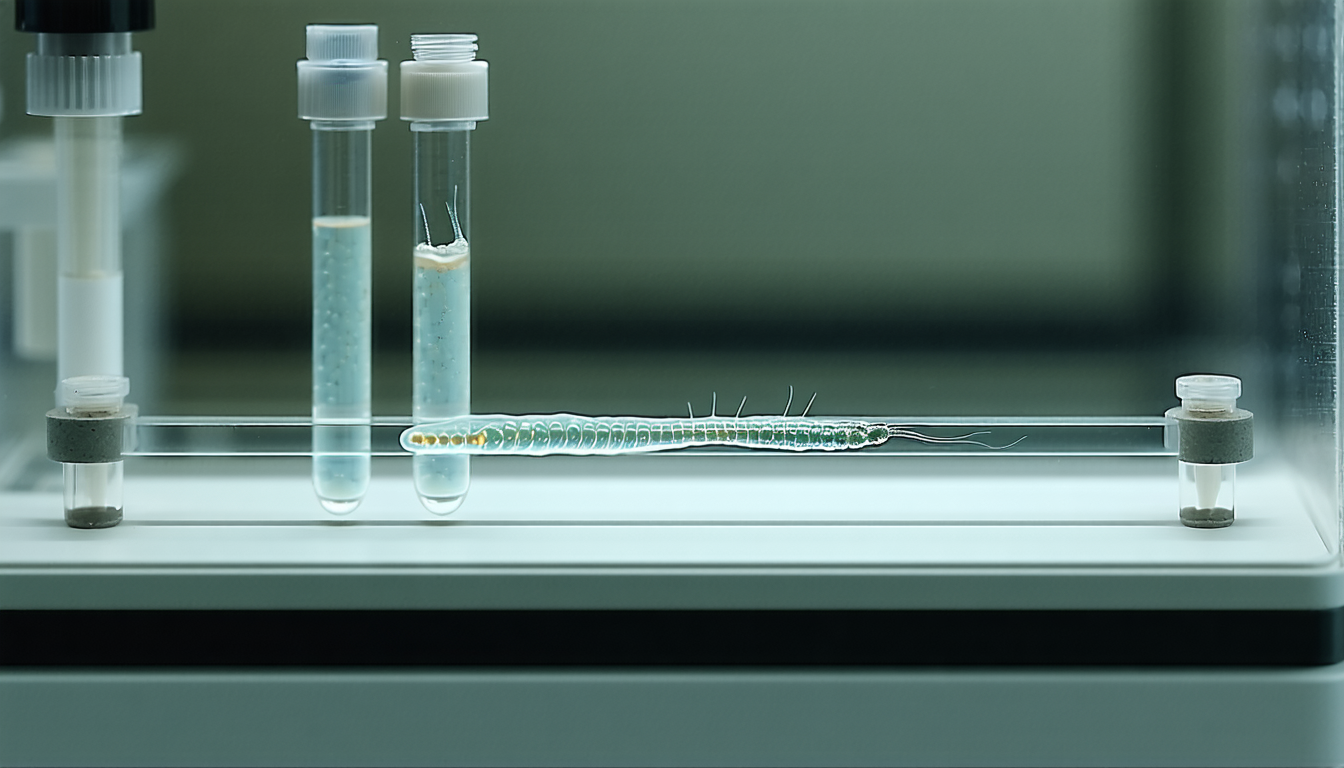
What happened
- Actin inhibitors suppressed the shape changes and crawling, pointing to an actin-based cytoskeleton like the one that drives shape change and movement in human cells.
- Earlier knowledge came from DNA sequencing and electron micrographs, which showed projections up to 20 times the cell body's length but nothing of how they moved.
- Philipp Radler led the work in Christa Schleper's Vienna lab, with co-authors from JAMSTEC, IST Austria and HZI Braunschweig.
Why it matters
- What's now possible capability Researchers can now watch living Asgard cells and block their behavior with drugs, so claims about the archaeal ancestor of eukaryotes can be checked against behavior as well as against genomes and fixed images.
- What it limits constraint The idea that crawling predates complex cells rests on two strains from two lineages, so independent evolution of the behavior stays open until more Asgard groups are cultured and filmed.
- Who has to decide decision Models of the bacterium-archaeon merger now have to say whether the archaeal partner could reach out and attach to surfaces, since the Vienna team argues crawling may have mattered in that symbiosis.
Next story · Science · 5h ago
Baker lab's from-scratch zinc proteases cut their chosen target in 36% of 135 designsConfirmed2 publishers
Asgard archaea are our closest known microbial relatives, and they sit at the centre of current models for how complex cells arose [4]. Until these films, the best pictures of them were electron micrographs. Those showed a round cell body ringed by delicate projections up to 20 times its length, and nothing about what the projections did [9]. Most of what is known about the group comes from those images and from DNA sequencing [9].
Filming them first required cultures. The first two specimens were grown only in 2020 and 2023, one at JAMSTEC in Japan and one in Christa Schleper's lab in Vienna [8]. The cells also had to stay alive under the lens, so the team filmed them in an oxygen-free environment [2]. The cells are tiny, about a thousandth the volume of a human cell [6]. If the two have similar shapes, that is roughly a tenth of the width [12].
In both strains, a Lokiarchaeon and a Heimdallarchaeon, the cells changed shape drastically every minute, attached to surfaces with their thin appendages and crawled across them [2][3]. That behavior had not been described in microbes before. The closest comparison the researchers offer is complex cells, including human immune cells [3].
The drug experiment is the control. Actin inhibitors suppressed the dynamic behavior. The team takes that as a sign of a central role for an actin-based cytoskeleton, the same class of machinery that shapes and moves human cells [11]. It is a pharmacological result, obtained on cultured cells under a microscope [2]. It ties the crawling to actin. How the protrusions generate force or grip a surface is a separate question.
The films do not show when crawling evolved. Current models put the first eukaryotes at about 2 billion years ago, formed when a bacterium fused with an ancestor of today's Asgard archaea [7]. The Vienna team argues that complex cell motility may be much older than previously thought and may have mattered in the ancient symbiosis that later produced mitochondria [13]. That inference rests on two living lineages. If Asgard archaea and eukaryotes both crawl on actin, the simplest explanation is a common ancestor that crawled. Separate origins stay possible until more lineages are filmed and their underlying proteins compared.
According to the University of Vienna, oxygen-free live-cell microscopy makes it possible for the first time to test models of the origin of complex life against experiment [14]. I think the method is the part of this work that will last. Sequence data and fixed images [9] describe what a cell encodes and how it looks. A film shows what the cell does, and the inhibitor test shows that the behavior can be switched off on purpose [11]. The press account does not report how many cells were tracked or how fast they moved.
What to watch
- Whether Asgard strains beyond this Lokiarchaeon and Heimdallarchaeon show the same actin-dependent crawling once they are cultured and filmed.
- Whether the oxygen-free imaging is used to watch Asgard cells alongside bacteria, the pairing that current models put at the origin of eukaryotes.
- Quantitative figures from the Nature paper: how many cells were tracked, crawling speeds, and what inhibitor doses stopped the behavior.
Clarity's read
What the record supports and how the coverage leans. The claims behind it follow.
Reality
- Evidence72
- Adoption
- Not scored
- Hype gap+25
- Incentives35
- Confidence70
Claim ledger
Ranked by verification strength, evidence, and original report placement.
- [1]
Asgard archaea cells extend long protrusions, retract them and use them to crawl across surfaces, a behavior previously known only in eukaryotes.
- [2]
Researchers placed Asgard archaea in an oxygen-free environment and filmed the living cells under a microscope, using two strains: a Lokiarchaeon cultivated in Vienna and a Heimdallarchaeon cultivated in Japan.
- [3]
Both organisms drastically change their cell shapes every minute and use thin, dynamic appendages to attach to surfaces and explore them with a crawling motion not previously described in microbes and previously observed only in more complex cells, including human immune cells.
- [4]
Asgard archaea are our closest known microbial relatives and play a key role in current models of the origin of eukaryotes; their biology has been poorly understood.
- [5]
The study, published in Nature in 2026 (Dynamic protrusions mediate crawling motility in Asgard Archaea), was led by microbiologists at the University of Vienna.
- [6]
Asgard archaea cells have a volume about a thousand times smaller than that of a human cell.
- [7]
Current models suggest the first eukaryotes emerged around 2 billion years ago from the fusion of a bacterium with an ancestor of today's Asgard archaea.
- [8]
The first two specimens of Asgard archaea were cultivated only recently, in 2020 and 2023, at the JAMSTEC Institute in Japan and in Schleper's laboratory at the University of Vienna.
- [9]
Most knowledge about Asgard archaea is based on DNA sequencing or electron microscopy; the images showed a round cell body with delicate projections up to 20 times longer than the body but provided no insight into dynamic behavior.
- [10]
The study was conducted by Philipp Radler in Christa Schleper's laboratory; the international team included Japanese microbiologists from JAMSTEC and collaborators from IST Austria and HZI Braunschweig.
- [11]
Actin inhibitors suppressed the dynamic behaviors, which the team says suggests a central role for an actin-based cytoskeleton, the machinery that also controls shape changes and motility in human cells.
- [12]
An Asgard cell is roughly a tenth the width of a human cell, if the two have similar shapes.
- [13]
The researchers say the discovery suggests complex cell motility may have much older origins than previously thought and may have been relevant in the ancient symbiosis from which mitochondria later emerged.
- [14]
According to the University of Vienna, the findings, particularly oxygen-free live-cell microscopy, make it possible to test models of the origin of complex life empirically for the first time.
Sources
2 independent publishers whose own reporting we read for this story.
- nature.comDynamic protrusions mediate crawling motility in Asgard archaea
1 article · September 29, 2026
- phys.orgAsgard archaea suggest crawling motility may be far older than previously thought
1 article · September 30, 2026
Topics and entities
Topics
- Origin of complex cells
- Live-cell imaging
- Archaea
Entities
- University of Vienna
- Christa Schleper
- Candidatus Lokiarchaeum ossiferum
- HZI Braunschweig
- Candidatus Margulisarchaeum peptidophilum
- Japan Agency for Marine-Earth Science and Technology
- Nature