DNA from bone scraps too small to identify turns up an extinct yak relative in Siberia
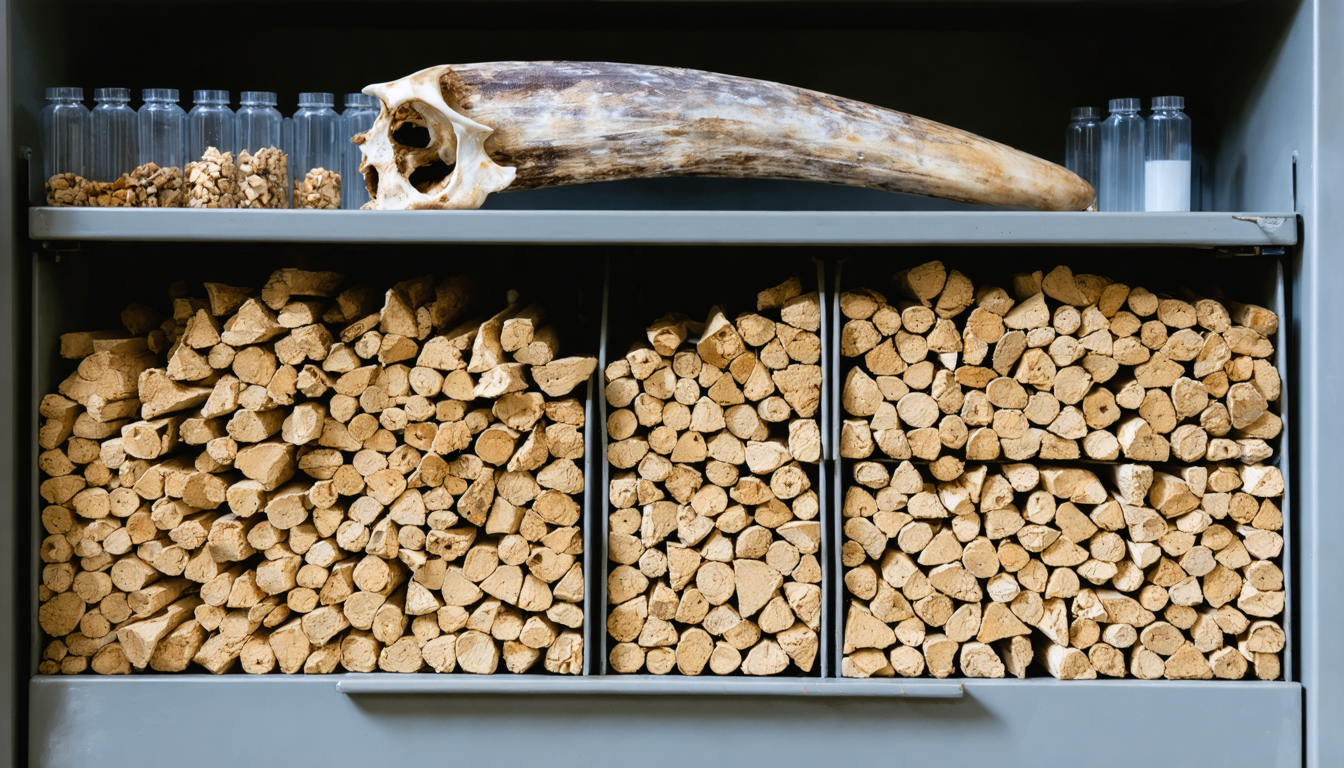
Stockholm-led paleogeneticists built 20 ancient genomes from unidentifiable Siberian bone scraps and found a yak relative that diverged 400,000 years ago. The result argues for sequencing fragments that shape cannot place, though the animal still needs anatomy before it gets a formal name.
The Scientist · Science desk
What happened
- The bone fragments came from Denisova Cave in the Altai foothills, three other nearby sites and one site near the Ural mountains.
- The genomes show negligible evidence of interbreeding with the steppe bison or aurochs that shared the region.
- A population replacement during the last interglacial warm period, about 130,000 to 115,000 years ago, came with a loss of genetic diversity.
- The youngest specimen is about 27,000 years old, and when and why the species died out are still unknown.
Why it matters
- What's now possible capability Fragment collections that shape-based identification cannot sort become a usable sample of large-mammal diversity wherever ancient DNA survives in them.
- What doesn't add up contradiction Coverage presents yak X as a previously unknown species, while Dalén himself suspects Russian palaeontologists already described its remains as a Himalayan yak subspecies.
- What it limits constraint Until the genomes are linked to diagnostic bones, statements about yak X's altitude tolerance or its role as prey for ancient humans can be argued only from find spots.
Next story · Science · Oct 9
Whole-body light-sheet maps turn up hundreds of previously unknown hair cells on squidConfirmed2 publishers
The screen was set up to answer a narrower question. Dalén's group started on the Denisova Cave fragments hoping to learn about bison evolution, New Scientist reported [10]. "But it turned out that nearly all bone fragments in the cave had DNA that didn't match any living bovine species, nor did it match the extinct steppe bison or aurochs," Dalén said [11]. An earlier study of trace amounts of DNA had already hinted that some of the fragments were unusual [13].
The design works because a fragment too small to assign by shape can still yield a genome [3]. Comparison with other bovine genomes then marked these as a previously unknown species, known so far only as yak X [1] [12]. "This is a remarkable discovery of a large extinct species based on small nondiagnostic bones," Dalén said [2].
The denominator is harder to pin down. Gilardet told New Scientist the team had access to hundreds of tiny fragments from the cave [4], and the full set, other sites included, produced genomes from 20 individuals [3]. The reports do not say how many fragments were screened or how many yielded no usable DNA. Another lab would need that yield before budgeting its own screen.
The species call rests on divergence time. The lineage began splitting from yaks about 400,000 years ago and was fully separate by about 250,000 years ago [5], so the separation took roughly 150,000 years [19]. "A useful comparison for when this lineage originated is the divergence between brown bears and polar bears, which has also been estimated to have occurred around 400,000 years ago. This age overlaps with a particularly strong warm climatic period, which could have prompted population isolation and, ultimately, speciation," Gilardet said [6]. The team itself says genetic evidence alone is not enough to formally classify and name a new species [7].
That caveat bears on how much bone shape actually missed. Dalén said the team suspects yak X might actually correspond to yak-like remains that Russian palaeontologists previously described as a subspecies of the Himalayan yak [8]. The team plans to compare its genomes with those described remains [7]. Until that work is done, it has no idea what traits set yak X apart, according to New Scientist [9].
Two of the more vivid claims are inferences. Every bone found so far comes from well below the Tibetan Plateau range of modern yaks, and Oppenheimer suggested yak X may have been less adapted to extreme mountain environments [15]. Find-spot elevation records where bones were recovered; it does not measure how the animal handled altitude. Dalén said Denisovans, Neanderthals, modern humans, hyenas and lions likely hunted it, though there is no direct evidence of that yet [22].
The coverage also disagrees on the end date. New Scientist puts the extinction by around 30,000 years ago [21], earlier than the youngest dated specimen in the phys.org and Popular Science accounts [20].
I think the evidence supports a narrower claim than the idea that DNA found what shapes missed. DNA established a species-depth split in an animal that may already be catalogued under another name, and it did so from fragments no one could identify by eye [2] [8]. The other gain is time depth: the 20 genomes span 200,000 years [3]. "The long time span of our data set is really rare in ancient DNA and allows us to look across whole glacial cycles to see how they might have impacted biodiversity," Oppenheimer said [16].
What to watch
- Whether the planned comparison with yak-like remains previously described as a Himalayan yak subspecies gives yak X a formal species name.
- Direct evidence that Denisovans, Neanderthals or modern humans hunted yak X, which Dalén calls likely but the team has not shown.
- A younger specimen or a published extinction estimate that settles when the species disappeared after about 27,000 years ago.
Clarity's read
What the record supports and how the coverage leans. The claims behind it follow.
Reality
- Evidence70
- Adoption
- Not scored
- Hype gap+15
- Incentives
- Not scored
- Confidence65
Perspective Coverage
3 publishers- Builder
- Builder 53%
- Operator
- Operator 40%
- Investor
- Investor 7%
Claim ledger
Ranked by verification strength, evidence, and original report placement.
- [1]
DNA analyses of ancient remains revealed a previously unknown extinct bovine species, related to modern yaks, that inhabited southern Siberia during and before the last ice age; comparisons with other bovine genomes showed the fossils belonged to a previously unknown species. Published in Current Biology.
- [2]
"This is a remarkable discovery of a large extinct species based on small nondiagnostic bones," said Love Dalén, senior author and professor of evolutionary genomics at the Center for Paleogenetics.
- [3]
By analyzing ancient DNA from unidentifiable bone fragments from Denisova Cave and other southern Siberian sites, researchers from the Center for Paleogenetics in Stockholm, UC Santa Cruz and the University of Vienna generated 20 ancient genomes spanning 200,000 years.
- [4]
The team was given access to hundreds of tiny bone fragments from Denisova cave, according to Alexandre Gilardet.
- [5]
The researchers estimate the species began diverging from modern yaks around 400,000 years ago and became fully separated around 250,000 years ago.
- [6]
"A useful comparison for when this lineage originated is the divergence between brown bears and polar bears, which has also been estimated to have occurred around 400,000 years ago. This age overlaps with a particularly strong warm climatic period, which could have prompted population isolation and, ultimately, speciation," said Alexandre Gilardet, a lead author and PhD student at the Center for Paleogenetics.
- [7]
Genetic evidence alone is not sufficient to formally classify and name a new species; the researchers plan to compare the findings with previously described yak-like remains from the region to determine whether they belong to the same species.
- [8]
"We suspect that yak X might actually correspond to yak-like remains that have been [previously] described by Russian palaeontologists as a subspecies of the Himalayan yak," said Dalén.
- [9]
Until further work is complete, including on other remains that may have been previously misidentified, the team has no idea what unique traits the new species may have had.
- [10]
Dalén and colleagues began studying bone fragments from Denisova cave in the hope of learning about bison evolution.
- [11]
"But it turned out that nearly all bone fragments in the cave had DNA that didn't match any living bovine species, nor did it match the extinct steppe bison or aurochs," said Dalén.
- [12]
The newly identified bovine is currently known only as yak X.
- [13]
An earlier study on trace amounts of DNA had suggested something special about some of the bone fragments found in and around Denisova Cave.
- [14]
Besides fragments from Denisova cave, in the foothills of the Altai mountains in Siberia, the team analysed material from three other nearby sites and one near the Ural mountains, and constructed genomes from 20 individuals.
- [15]
All the bones found so far are much lower in elevation than the Tibetan Plateau, the native range of modern yaks, which means yak X may have been less adapted to extreme mountain environments, according to Jonas Oppenheimer.
- [16]
"The long time span of our data set is really rare in ancient DNA and allows us to look across whole glacial cycles to see how they might have impacted biodiversity," said Jonas Oppenheimer, a lead author and postdoctoral researcher at the Center for Paleogenetics.
- [17]
The scientists detected negligible evidence for interbreeding between the new species and other bovines in the area, such as steppe bison or aurochs.
- [18]
A population replacement likely occurred during the last interglacial warm period, between about 130,000 and 115,000 years ago, accompanied by a loss of genetic diversity.
- [19]
The separation of the lineage from yaks took roughly 150,000 years, from the start of divergence to full separation.
- [20]
The youngest specimen analyzed is around 27,000 years old; the species became extinct sometime after that, but the exact timing and causes remain unknown.
- [21]
New Scientist reported the species became extinct by around 30,000 years ago.
- [22]
There is so far no direct evidence of yak X being hunted, but Dalén said it is likely that Denisovans, Neanderthals, modern humans and large carnivores such as hyenas and lions targeted them as prey.
Sources
3 independent publishers whose own reporting we read for this story.
- newscientist.comExtinct yak relative discovered from DNA in Denisova cave
1 article · October 5, 2026
- phys.orgExtinct bovine species discovered in Siberia reveals lost relative of yaks
1 article · October 5, 2026
- popsci.comExtinct ice age bovine discovered in Siberian cave
1 article · October 5, 2026
Topics and entities
Topics
- Ancient DNA
- Pleistocene Megafauna
Entities
- Alexandre Gilardet
- Stockholm University
- Jonas Oppenheimer
- Current Biology
- Centre for Palaeogenetics