Danaher builds an AI lab at Abcam to make hundreds of reagents a year instead of tens
Danaher's first autonomous lab, at Abcam, is projected to lift yearly reagent output tenfold, from tens to hundreds, once at full capacity in early 2027. Danaher has disclosed no cost, so the reagent count it reports in 2027 is what the plan will be judged on.
The Investor · Invest desk
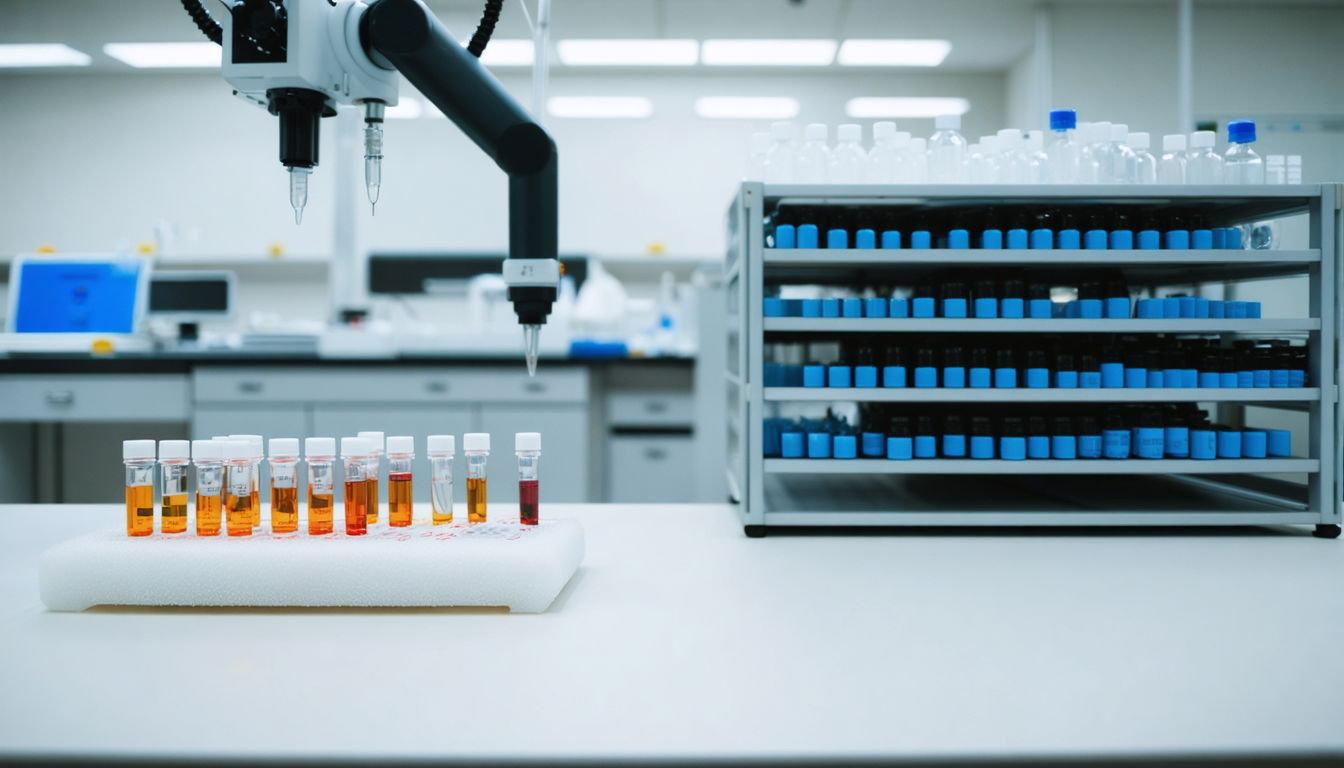
What happened
- The lab combines AI and robotics with tools from Beckman Coulter Life Sciences, Cytiva, Genedata, Integrated DNA Technologies and Molecular Devices in one workflow.
- Automata, a company Danaher invested in during January 2026, developed the lab's device orchestration and robotic automation.
- Danaher projects its design, build, test and feedback loop will move a reagent from idea to validation up to eight times faster.
Why it matters
- What doesn't add up contradiction CNA's version states the speed gain as a flat eight times, while Danaher's wording is up to eight, so the best case is already being repeated as the forecast.
- What it costs cost With no budget disclosed for the lab or the Automata investment, investors can judge the tenfold claim only on reagent counts, with no way to measure return per dollar spent.
- Who's exposed exposure A tens-to-hundreds target with an early 2027 date attached gives Danaher a public number it can miss, and the miss would be countable.
- What it sets up precedent Whoever runs the next autonomous lab, Danaher or an outside research program, will show whether the instrument fleet is a product line or internal overhead.
Next story · Invest · yesterday
AstraZeneca's insitro deal puts 2.7% of its disclosed value up frontConfirmed4 publishers
Danaher put a qualifier on only one of its two projections. It projects progress from idea to validated reagent at "up to" eight times faster [5], and yearly output rising tenfold, from tens of reagents to hundreds [6]. Ten divided by eight leaves a factor of 1.25 [13]. A loop that ran eight times faster would on its own lift yearly output about eightfold, so the rest has to come from running more candidates at once. If the speed gain falls short of its ceiling, parallel capacity has to carry more of the tenfold figure. The version of the announcement published by CNA drops the qualifier and calls molecule discovery eight times faster [10].
Danaher's chief science officer put the weight on speed. "Speed is what supercharges that cycle. Every result sharpens the next design, so the faster each loop runs, the faster discovery compounds," JC Gutierrez-Ramos said [7]. He said scientists would keep making the key decisions while the platform handles repetitive experimental work [8]. "That frees them (scientists) to focus on the complex scientific challenges where human insight matters most," he said [12].
The loop produces research reagents. The model designs affinity reagents, antibodies among them, and each candidate is built and tested before the results go back into the model [4]. Coverage framed the lab as drug discovery [10]. By Danaher's description, what it makes is the custom antibodies and other molecular tools that scientists use in that work [1]. Hundreds a year is the output expected once the Abcam site reaches full operating capacity in early 2027 [2].
The announcement did not include a cost for the lab or the size of Danaher's January 2026 investment in Automata [11]. Without either, nobody can yet work out a price per added reagent. The better guide to where the money is meant to go (or rather, where Danaher says it wants it to go) is the plan around the lab. Danaher called it the first step toward a fleet of smart instruments that produce AI-ready data and include expert-level agentic systems, connected into integrated workflows and more autonomous labs [9]. This first site already runs tools from five operating companies in one workflow [3].
I think the lab is mainly a working demonstration for that instrument fleet, and the reagents are the evidence that the loop runs. Two other outcomes fit the evidence. The strongest case against my view is that the lab stays an in-house reagent line, and the further labs Danaher describes, running the same loop across research programs [9], are all its own. Or the early 2027 date [2] slips, leaving one site and a projection. If the next autonomous lab Danaher announces also sits inside one of its own companies, the demonstration view is wrong.
What to watch
- The reagent count Danaher reports once the Abcam lab reaches full operating capacity in early 2027, set against the hundreds a year projected.
- Any disclosure of the size or terms of Danaher's January 2026 investment in Automata, or a further deal between the two.
- Whether Beckman Coulter Life Sciences, Molecular Devices or the other operating companies begin selling the smart instruments as a packaged workflow.
Information, not investment advice. This story is general information about companies and markets, drawn from cited reporting. It is not a recommendation to buy, sell or hold any security; check the cited sources before acting.
Clarity's read
What the record supports and how the coverage leans. The claims behind it follow.
Reality
- Evidence30
- Adoption
- Not scored
- Hype gap+40
- Incentives70
- Confidence60
Perspective Coverage
3 publishers- Builder
- Builder 33%
- Operator
- Operator 32%
- Investor
- Investor 35%
Claim ledger
Ranked by verification strength, evidence, and original report placement.
- [1]
Danaher announced plans on Wednesday to launch its first AI-powered autonomous research lab, designed to help scientists develop custom antibodies and other molecular tools faster and more efficiently.
- [2]
The lab is based at Abcam, a Danaher company, and is expected to reach full operating capacity in early 2027.
- [3]
The lab brings together AI, robotics and capabilities from Danaher operating companies Beckman Coulter Life Sciences, Cytiva, Genedata, Integrated DNA Technologies and Molecular Devices within a unified, end-to-end workflow.
- [4]
The system applies AI to conceive new affinity reagents, antibodies among them, advances each candidate through construction and testing, and continuously returns experimental outcomes to the model to sharpen subsequent iterations.
- [5]
Danaher said the design-make-test-learn loop is projected to deliver up to eight times faster progress from idea to validated reagent.
- [6]
Danaher said the loop is projected to deliver a tenfold increase in annual reagent generation, scaling from tens to hundreds of reagents per year.
- [7]
"Speed is what supercharges that cycle. Every result sharpens the next design, so the faster each loop runs, the faster discovery compounds." (JC Gutierrez-Ramos, Senior Vice President and Chief Science Officer of Danaher)
- [8]
Gutierrez-Ramos said scientists would continue to make key decisions while the platform handles repetitive experimental work.
- [9]
Danaher said the lab is the first step in a broader initiative to build a fleet of smart instruments that produce AI-ready data and include expert-level agentic systems, which would connect to create integrated workflows and additional autonomous labs capable of running design-make-test-learn cycles across research programs.
- [10]
Danaher said on Oct 7 it plans to launch the lab to make drug discovery and development faster and more efficient; the lab is expected to make discovering molecules eight times faster and unlock a tenfold increase in generating target-binding molecules annually.
- [11]
Device orchestration and robotic automation were developed in collaboration with Automata, a company in which Danaher invested in January 2026.
- [12]
"That frees them (scientists) to focus on the complex scientific challenges where human insight matters most." (JC Gutierrez-Ramos)
- [13]
The projected output gain (10x) exceeds the projected maximum speed gain (8x) by a factor of 1.25.
Sources
3 independent publishers whose own reporting we read for this story.
- channelnewsasia.comLife sciences firm Danaher to launch AI-powered autonomous research lab in 2027
1 article · October 7, 2026
- cryptopolitan.comDanaher to launch AI-powered lab for drug discovery in 2027
1 article · October 7, 2026
- qz.comDanaher is launching an AI-powered autonomous lab for drug discovery
1 article · October 7, 2026
Topics and entities
Topics
- Antibodies and affinity reagents
- AI Drug Discovery
- Autonomous and self-driving laboratories
Entities
- Molecular Devices
- Julie Sawyer Montgomery
- JC Gutierrez-Ramos
- Integrated DNA Technologies
- Beckman Coulter Life Sciences