Flinders researchers make the case for vanillin in chronic-wound treatments
Flinders researchers argue vanillin's antioxidant, anti-inflammatory and antibacterial activity makes it a candidate for chronic-wound formulations. Most of their case rests on cheap supply and a long record in food, and the published account does not say how much vanillin speeds healing.
The Scientist · Science desk
What happened
- The paper, with Borislav Stoilov as first author, is published in the International Journal of Pharmaceutics.
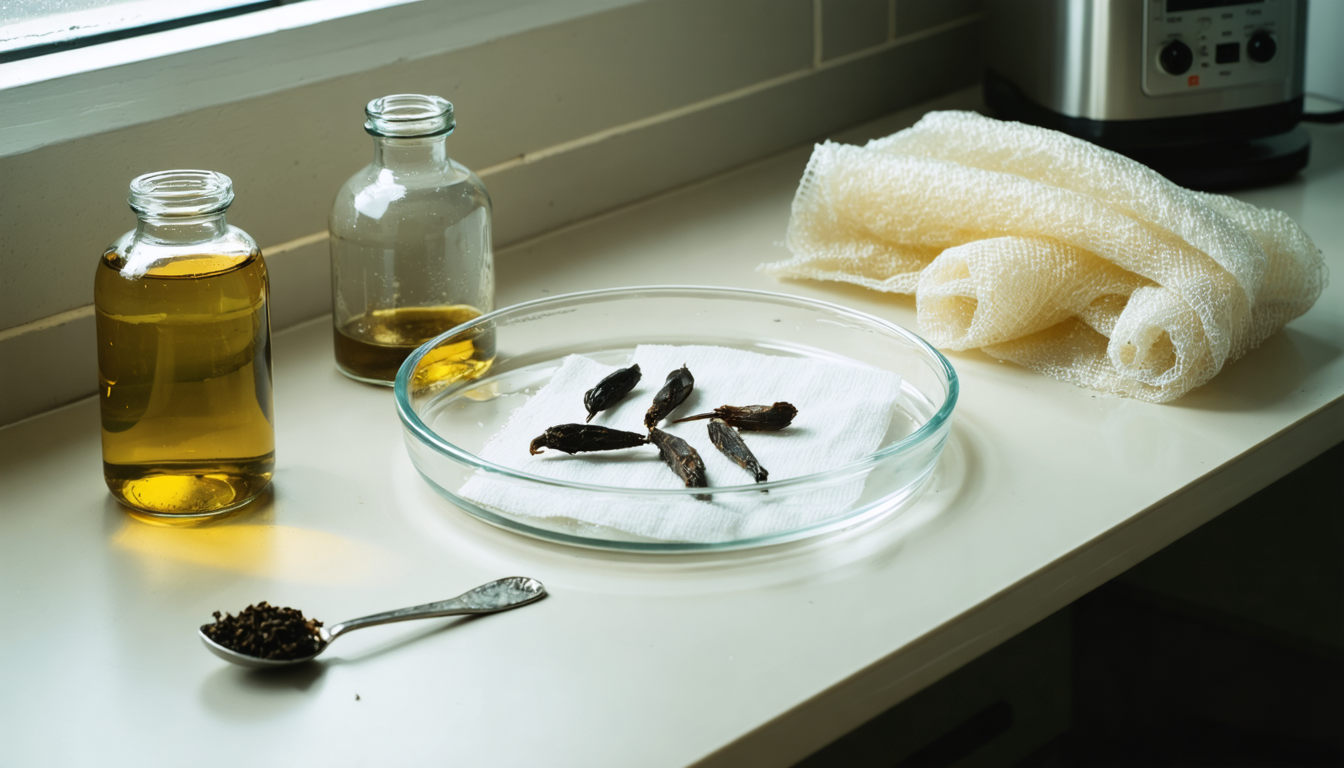
- Vanillin is the main compound extracted from vanilla pods, and it can also be made synthetically from clove oil or rice.
- Beyond flavouring food, vanillin already has a role in materials design as a dynamic crosslinker and functional element.
- The work extends an earlier Flinders peppermint-oil coating, reported in Small in February 2026, that guarded against infection, inflammation and oxidative stress.
Why it matters
- What it limits constraint The safety record behind the pitch comes from eating vanillin as a flavouring, so any wound product would still need its own dosing and tolerance data for open tissue.
- What it costs cost If a vanillin formulation proves effective, a cheap synthetic small molecule would keep ingredient cost and supply risk low for whoever manufactures it.
- Who has to decide decision A wound-care company interested in vanillin would have to fund comparative healing studies itself, because the case so far rests on listed properties and price.
Next story · Science · 2d ago
Divers find more than 20 stone artefacts at two submerged sites off MurujugaConfirmed2 publishers
The first thing to ask of a wound-healing claim is the effect size. How much faster did a wound close, or how far did a bacterial count fall, and compared with what? The phys.org account calls vanillin's antioxidant, anti-inflammatory and antibacterial properties "pronounced" [1]. It does not report a measurement, a control, a bacterial strain or a wound model.
The paper's title presents vanillin "as a bioactive component in biomedical formulations for chronic wound healing and tissue regeneration" [2]. According to phys.org, the team placed vanillin in a "food-to-function framework" that links its chemistry to biological activity and potential biomedical applications [5]. A framework like that helps researchers pick a candidate. Testing whether the candidate helps a chronic ulcer heal takes a separate study, with a comparison arm and a healing endpoint.
The chemical argument comes from Krasimir Vasilev, professor of biomedical nanotechnology at Flinders and director of its Biomedical Nanoengineering Laboratory [8]. "Owing to its amphiphilic molecular structure, vanillin can interact with reactive oxygen species, cellular membranes and polymeric matrices, providing a basis for its incorporation into functional formulations," he said [7]. He also proposes vanillin-based formulations for "ulcer treatment and targeted drug delivery, especially of hydrophobic compounds" [12].
The safety argument is where I would be most careful. Vasilev said vanillin is "among the most widely used flavor compounds in the global food system, valued for its sensory attributes, chemical stability and long history of safety," and that this "can be transferred to other areas, such as medical uses" [6]. That history comes from people eating vanillin as a flavouring. A chronic wound is open tissue. The food record does not tell you what concentration a dressing would need, or how a wound bed tolerates it.
The manufacturing argument is on firmer ground. Vasilev described vanillin's synthetic form as "abundant and cost-effective" [12]. The team argues that a low-cost small molecule compatible with good manufacturing helps with industrial scale-up, reproducible formulations and a steady supply chain [11].
The food line of work at Flinders has a homely origin. According to phys.org, Vasilev noticed that eating the peppermint leaves from his drink noticeably eased a sore throat. He then wondered whether that bioactivity could be turned into a durable coating using plasma technology, which he has researched for more than two decades [10].
I think vanillin is a sensible molecule to test in a wound model, and the supply case is the most concrete part of what the team has said so far [11]. Vasilev puts the next step down to collaboration. "With coordinated engagement between academia, clinicians and industry, vanillin has the potential to progress from an underutilized bioactive to a clinically deployable component of next-generation wound care and regenerative therapeutics," he said [13].
What to watch
- A controlled study reporting healing time or bacterial load for a vanillin formulation against a standard dressing in an animal or human chronic-wound model.
- Whether the full International Journal of Pharmaceutics paper contains new laboratory measurements or gathers findings from earlier studies.
- Named clinical or industry partners taking up the collaboration Vasilev says vanillin needs to reach clinical use.
Clarity's read
What the record supports and how the coverage leans. The claims behind it follow.
Reality
- Evidence32
- Adoption
- Not scored
- Hype gap+40
- Incentives70
- Confidence55
Claim ledger
Ranked by verification strength, evidence, and original report placement.
- [1]
A team from Flinders University's Biomedical Nanoengineering Laboratory found that vanillin has pronounced antioxidant, anti-inflammatory and antibacterial properties, making it a good candidate for wound-healing formulations.
- [2]
The work is published in the International Journal of Pharmaceutics (2026) as Borislav Stoilov et al, 'Vanillin as a bioactive component in biomedical formulations for chronic wound healing and tissue regeneration', DOI 10.1016/j.ijpharm.2026.127263.
- [3]
Vanillin is the primary chemical component extracted from natural vanilla pods, but it can also be synthetically produced from clove oil or rice.
- [4]
Apart from being a sensory additive, vanillin is a functional molecule, serving as a dynamic crosslinker and functional element in material design.
- [5]
By placing vanillin within a food-to-function framework, the researchers linked its chemical properties to biological activity and potential biomedical applications.
- [6]
Vasilev said vanillin is "among the most widely used flavor compounds in the global food system, valued for its sensory attributes, chemical stability and long history of safety" and that "can be transferred to other areas, such as medical uses."
- [7]
"Owing to its amphiphilic molecular structure, vanillin can interact with reactive oxygen species, cellular membranes and polymeric matrices, providing a basis for its incorporation into functional formulations."
- [8]
Krasimir Vasilev is professor of biomedical nanotechnology at Flinders University and director of Flinders' Biomedical Nanoengineering Laboratory.
- [9]
Flinders researchers previously created a nanoscale peppermint oil-derived coating, described in the journal Small in February 2026, that protects against infection, inflammation and oxidative stress while remaining compatible with human tissue.
- [10]
The food-based research idea emerged after Vasilev noticed that eating peppermint leaves from his drink significantly relieved his sore throat, inspiring him to explore converting its bioactivity into a durable coating using plasma technology, which he has researched for more than two decades.
- [11]
The researchers say vanillin's availability as a low-cost small molecule compatible with good manufacturing offers a clear advantage for industrial scale-up, formulation reproducibility and supply chain robustness.
- [12]
"Because vanillin's synthetic form is abundant and cost-effective, we believe vanillin-based formulations may offer safe and multifunctional solutions for ulcer treatment and targeted drug delivery, especially of hydrophobic compounds."
- [13]
"With coordinated engagement between academia, clinicians and industry, vanillin has the potential to progress from an underutilized bioactive to a clinically deployable component of next-generation wound care and regenerative therapeutics."
Sources
2 independent publishers whose own reporting we read for this story.
- phys.orgVanillin provides a sweet solution for chronic wound healing
1 article · October 6, 2026
- popsci.comVanilla could help heal wounds
1 article · October 6, 2026
Topics and entities
Topics
- Chronic Wound Care
Entities
- International Journal of Pharmaceutics
- Biomedical Nanoengineering Laboratory
- Flinders University
- Krasimir Vasilev
- Borislav Stoilov