Synchrotron scans find gills in Westlothiana, the fossil long cited as the earliest land-adapted amniote
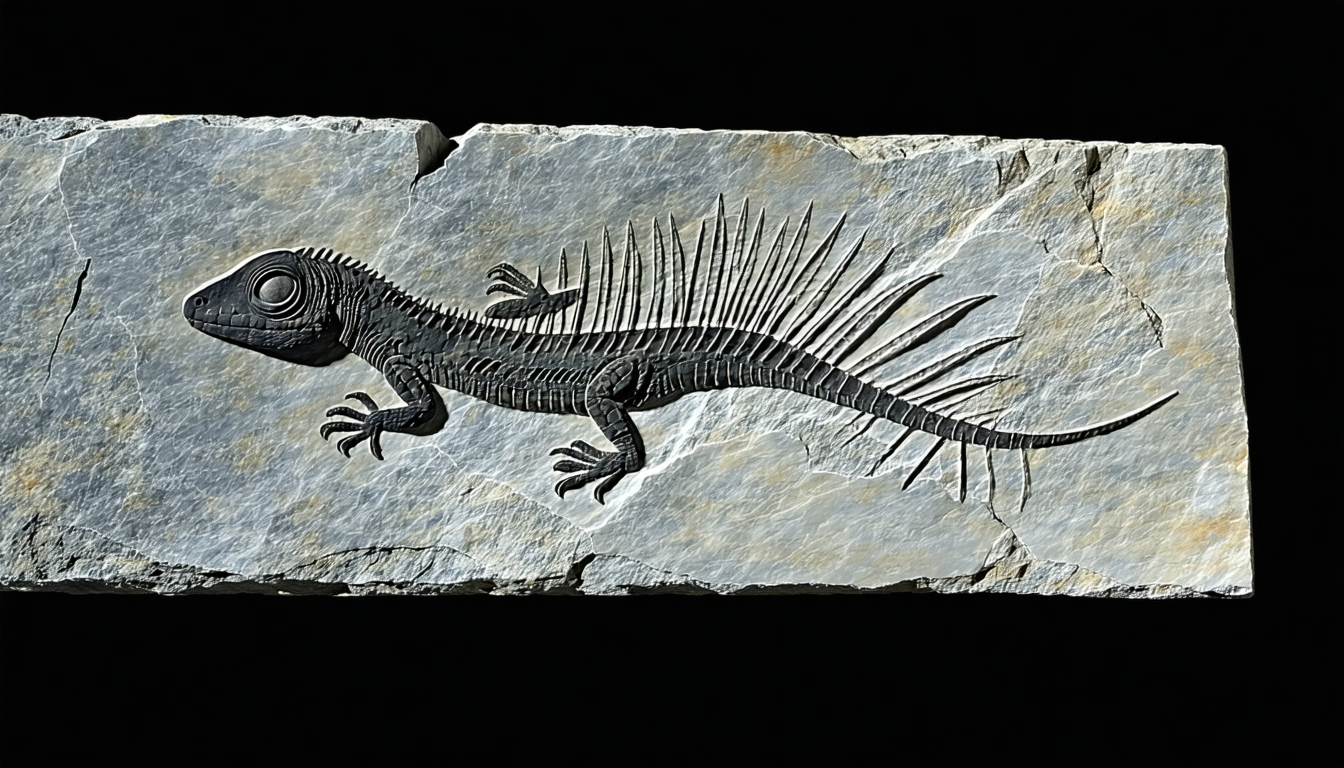
AMNH and Oxford researchers report in Nature that 345-million-year-old Westlothiana had gills and a primitive skull. That takes away a fossil researchers have long used to date the origin of the group that includes reptiles, birds and mammals.
The Scientist · Science desk
What happened
- The authors conclude Westlothiana lived in water or moved between water and land, and that features of its skull rule it out as an ancestor of reptiles.
- Found in Scotland in 1984 and described in 1990, the fossil had been interpreted mostly from what was visible on the surfaces of two crushed slabs.
- Clawed trackways recently used to argue that amniotes arose in the Devonian, more than 359 million years ago, may instead have been made by amphibious tetrapod relatives.
Why it matters
- What it limits constraint A clawed footprint can no longer identify an amniote by itself, so any case for a Devonian origin of the group needs evidence beyond claw marks.
- Who has to decide decision Timelines that used Westlothiana as the earliest land-adapted amniote now have to drop that data point or move it to the tetrapod stem lineage.
- What it limits constraint A reptile-like foot or a weight-bearing forelimb becomes weak evidence on its own that an early fossil lived on land, because such traits built up gradually in relatives that still lived partly in water.
Next story · Science · 5h ago
Baker lab's from-scratch zinc proteases cut their chosen target in 36% of 135 designsConfirmed2 publishers
This whole result rests on one animal. Westlothiana survives as two crushed slabs, deformed and hard to interpret [15], and the 1990 description worked mostly from what showed on their surfaces [2]. Seen from the surface it looked like a land animal: a nearly complete skeleton, four limbs, and fingers and toes with claw-like tips, at a time when many of its contemporaries had more fin-like limbs [3].
The new work did not need a new specimen. The team took the slabs to the European Synchrotron Radiation Facility in Grenoble, where X-rays pass through the rock and let researchers reconstruct structures hidden inside it [5]. "But when we were finally able to see inside the fossil, we found an animal that looked very different from what we expected," said Xavier Jenkins, a postdoctoral fellow at the American Museum of Natural History and co-lead author [6]. Besides the gills and the primitive skull, the scans showed a fish-like mouth lined with thousands of tiny teeth [7].
I'd weigh the anatomy as the firmest part of the paper. Ossified gills and a fish-like mouth are hard to square with a land animal, and the authors conclude it was aquatic or amphibious [7][8]. "The surprisingly primitive features of the skull show us that Lizzie was not only not a reptile but belonged to a much more ancient lineage," said Ben Igielman, the other co-lead author, who began the work as a graduate student at Oxford [9].
The claws matter more than the reclassification itself. If Westlothiana sits on the tetrapod stem, then claws and five digits on the hands and feet had already evolved in earlier, more aquatic members of that lineage [10]. "It shows that, although we think of amphibians as being more 'primitive' than reptiles today, some of the traits of reptiles were already there in the ancestor of both amphibians and reptiles," said co-author Roger Benson, the museum's Macaulay curator of paleontology [11].
That changes how footprints can be read. Trackways showing a four-limbed walker with claw-like digits have recently been used to argue that amniotes arose in the Devonian, more than 359 million years ago [12]. On that reading, amniotes would have been around at least 14 million years before Westlothiana [16]. If a gilled stem animal also had claws, a clawed print alone cannot identify an amniote, and the authors say some tracks credited to early amniotes may have been made by amphibious tetrapod relatives [13]. The scans show that a claw is not enough to identify an amniote. Assigning any particular Devonian trackway to a different maker would take separate work on those tracks.
Since 1990, researchers have often used Westlothiana as a landmark in arguments about when amniotes appeared [4]. The phys.org account of the Nature paper does not name a fossil to replace it or give a revised origin date [5]. "The broader lesson is that terrestrial-looking traits, such as a reptile-like foot, a weight-bearing forelimb and claw-like phalanges, were not unique features of tetrapods, but rather accumulated piecemeal in their close relatives, in animals that were still living in and out of the water," Jenkins said [14].
What to watch
- Whether the teams behind the Devonian trackways re-examine tracks attributed to early amniotes now that clawed stem tetrapods are documented.
- Which fossil the authors or other groups put forward as the earliest land-adapted amniote, and at what date.
- Whether other early tetrapod specimens described mainly from surface anatomy are sent for synchrotron scanning.
Clarity's read
What the record supports and how the coverage leans. The claims behind it follow.
Reality
- Evidence62
- Adoption
- Not scored
- Hype gap+8
- Incentives25
- Confidence64
Claim ledger
Ranked by verification strength, evidence, and original report placement.
- [1]
The Westlothiana lizziae fossil, from Scotland and nicknamed 'Lizzie', is 345 million years old and was discovered in 1984.
- [2]
Westlothiana was described in 1990, originally mostly from what is visible on the surface of its two crushed slabs.
- [3]
The surface shows a nearly complete skeleton with four limbs and fingers and toes bearing superficially claw-like tips, features that set it apart from many contemporaries with more fin-like limbs.
- [4]
Westlothiana was widely cited as the earliest land-adapted amniote (the group including reptiles, birds and mammals) and since 1990 has been frequently used as a landmark fossil in discussions of the origin and timing of amniotes; it was celebrated for nearly 30 years as one of the earliest reptiles.
- [5]
The study, published in Nature and led by the American Museum of Natural History and the University of Oxford with the European Synchrotron Radiation Facility, used X-ray scanning at the ESRF in Grenoble to see through the rock and reconstruct structures not visible from the surface.
- [6]
"But when we were finally able to see inside the fossil, we found an animal that looked very different from what we expected." - Xavier Jenkins, AMNH postdoctoral fellow and co-lead author
- [7]
The scans revealed a primitive skull, ossified internal gills and a fish-like mouth lined with thousands of tiny teeth, features that rule out Westlothiana as an ancestor of reptiles.
- [8]
The findings suggest the animal was aquatic or amphibious, not terrestrial.
- [9]
"The surprisingly primitive features of the skull show us that Lizzie was not only not a reptile but belonged to a much more ancient lineage." - Ben Igielman, co-lead author, who started the research during graduate work at Oxford
- [10]
The researchers conclude that traits once assumed exclusive to land-adapted amniotes, including claws and five digits on hands and feet, had already evolved among earlier, more aquatic members of the tetrapod stem lineage.
- [11]
"It shows that, although we think of amphibians as being more 'primitive' than reptiles today, some of the traits of reptiles were already there in the ancestor of both amphibians and reptiles." - Roger Benson, AMNH Macaulay curator of paleontology, co-author
- [12]
Fossil trackways preserving impressions of a four-limbed animal with claw-like digits have recently been used to show that amniotes originated during the Devonian Period, more than 359 million years ago.
- [13]
If early tetrapod relatives such as Westlothiana had claws, clawed tracks alone can no longer establish that their maker was an amniote; some trackways attributed to early amniotes may have been made by more primitive, amphibious tetrapod relatives.
- [14]
"The broader lesson is that terrestrial-looking traits, such as a reptile-like foot, a weight-bearing forelimb and claw-like phalanges, were not unique features of tetrapods, but rather accumulated piecemeal in their close relatives, in animals that were still living in and out of the water." - Xavier Jenkins
- [15]
The Westlothiana fossil is deformed and difficult to interpret.
- [16]
Devonian trackways dated to more than 359 million years ago would place amniotes at least 14 million years before the 345-million-year-old Westlothiana.
Sources
2 independent publishers whose own reporting we read for this story.
- discovermagazine.comThe 345-Million-Year-Old Landmark Fossil “Lizzie” Was Not a Reptile — It Had Gills and a Fish-Like Mouth
1 article · October 1, 2026
- phys.orgFossil long known as world's oldest reptile dethroned
1 article · September 30, 2026
Topics and entities
Topics
- Tetrapod evolution
- Paleontology
- Synchrotron imaging
Entities
- American Museum of Natural History
- University of Oxford
- Westlothiana lizziae
- Nature
- European Synchrotron Radiation Facility