Northwestern team ties cannabinoid anxiety in mice to one cell group in the fear center
Northwestern scientists traced cannabinoid anxiety in mice to one group of neurons in the amygdala, work reported October 2 in Nature Communications. Silencing those cells left the drugged mice less fearful of a predator odor.
The Scientist · Science desk
What happened
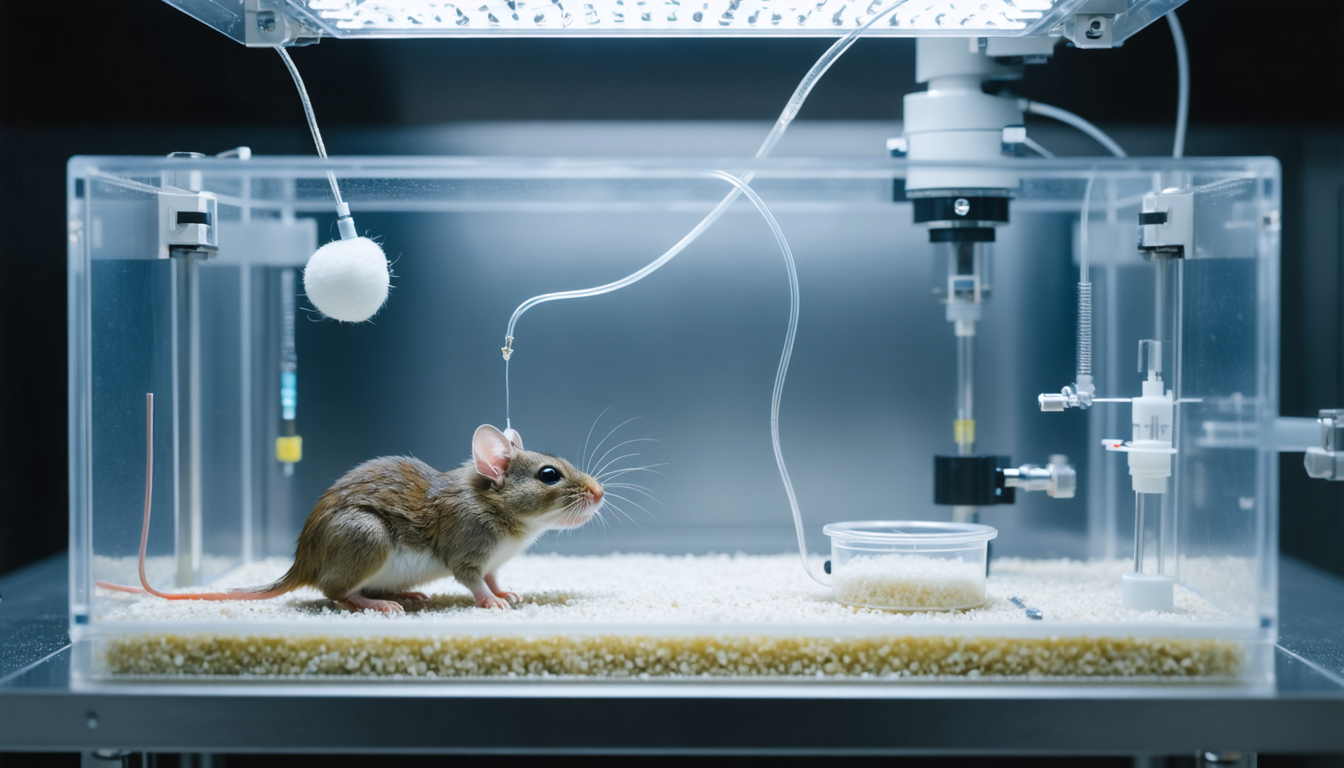
- Before meeting a threatening fox-urine odor, mice were given either a placebo or a synthetic cannabinoid, and the cannabinoid group froze more often and spent less time investigating the scent.
- The researchers watched activity inside the brain through an implanted miniature microscope and ran the test across several different doses of the drug.
- In brain tissue, the drug weakened a natural mechanism that normally restrains the somatostatin neurons, and with that brake eased the cells fired more.
Why it matters
- What's now possible capability Switching off one cell type was enough to curb the drug's anxious effect, so a potential target narrows from the brain-wide cannabinoid system to a defined population of neurons.
- What it limits constraint The silencing was done with genetic tools in mice, and the team tested whether it lowered anxious behavior, not whether it would preserve the effects people take cannabinoids for.
- What it sets up precedent Patel casts the same neurons as a possible 'final pathway' for anxiety well beyond cannabis, a larger claim the study did not set out to test.
Next story · Science · Oct 2
Silencing amygdala somatostatin neurons blunts cannabinoid-boosted fear of fox odor in miceConfirmed2 publishers
In the recordings, the somatostatin neurons grew more active as the mice behaved anxiously [1]. That the two rise together does not say one drives the other. The test for cause came from the manipulation: with the neurons genetically silenced, the cannabinoid-treated mice became less likely to avoid the predator odor [2]. It is the first time this cell group has been tied to cannabinoid-driven anxiety [3].
Patel put dose and stress together. "Higher doses of cannabinoids and environmental stress worked together to synergistically release the 'brake' on the central amygdala, which in turn drove excessive anxiety," said Dr. Sachin Patel, the study's senior author and chair of psychiatry and behavioral sciences at Northwestern University Feinberg School of Medicine [8][9].
"The results of this study could explain why a good trip can turn bad pretty quickly if people consume too much cannabis or the situation they are in turns stressful or scary," Patel said [12].
The work was published October 2 in Nature Communications [4]. Cannabis use in the United States has risen in recent years, and emergency-department visits for the drug's adverse effects have risen with it [10]. Earlier studies link cannabis use to a higher long-term risk of anxiety, an association rather than a demonstrated cause [11]. The release does not report how many mice were tested or how large the effects were.
What to watch
- Whether the effect reproduces with THC or whole cannabis, and whether the full paper reports sample sizes and effect magnitudes.
- Whether suppressing these neurons can ease anxiety without blunting the effects people seek from cannabinoids.
- Whether Patel's 'final pathway' idea holds in anxiety models that have nothing to do with cannabis.
Clarity's read
What the record supports and how the coverage leans. The claims behind it follow.
Reality
- Evidence62
- Adoption
- Not scored
- Hype gap+25
- Incentives40
- Confidence65
Claim ledger
Ranked by verification strength, evidence, and original report placement.
- [1]
The researchers traced the anxiety-related behaviors to increased activity in somatostatin neurons in the central amygdala, a brain area involved in processing fear and stress.
- [2]
When the researchers genetically silenced the somatostatin neurons, the mice that received the cannabinoid became less likely to avoid the predator odor.
- [3]
Northwestern researchers say it is the first time a specific group of neurons has been identified as contributing to anxiety caused by cannabinoid drugs, particularly when combined with stressful conditions.
- [4]
The study, titled 'Cannabinoid Modulation of Central Amygdala Population Dynamics During Threat Investigation,' was published October 2 in Nature Communications.
- [5]
Mice were given either a placebo or a synthetic cannabinoid before being exposed to a threatening odor derived from fox urine; the mice that received the cannabinoid froze more frequently and spent less time exploring the predator scent.
- [6]
Experiments on brain tissue showed the cannabinoid weakened a natural mechanism that normally acts as a brake on the somatostatin neurons, and with that restraint reduced the neurons became more active.
- [7]
The team monitored brain activity by implanting a small microscope in the mice's brains and gave the animals several different doses of the synthetic cannabinoid.
- [8]
Higher doses of cannabinoids and environmental stress worked together to synergistically release the 'brake' on the central amygdala, which in turn drove excessive anxiety.
- [9]
Dr. Sachin Patel is the study's senior author and chair of psychiatry and behavioral sciences at Northwestern University Feinberg School of Medicine.
- [10]
Cannabis use in the U.S. has steadily increased in recent years, and emergency department visits involving adverse effects from the drug have also risen.
- [11]
Previous studies have found an association between cannabis use and a higher long-term risk of anxiety.
- [12]
The results of this study could explain why a good trip can turn bad pretty quickly if people consume too much cannabis or the situation they are in turns stressful or scary.
- [13]
Suppressing the activity of somatostatin neurons in the central amygdala could represent a final pathway for reducing anxiety symptoms, not just in the context of cannabis side effects.
Sources
2 independent publishers whose own reporting we read for this story.
- sciencedaily.comWhat happens in the brain when cannabis makes you anxious?
1 article · October 6, 2026
- scientificamerican.comWhy does weed cause anxiety? A new brain study investigates cannabis paranoia
1 article · October 7, 2026
Topics and entities
Topics
- Anxiety and fear circuits
- Cannabinoid neuroscience
- Preclinical Animal Research
Entities
- Northwestern University
- Brain & Behavior Research Foundation
- National Institutes of Health
- Ozge Gunduz-Cinar
- National Institute on Alcohol Abuse and Alcoholism
- Nature Communications
- Northwestern University Feinberg School of Medicine