Microplastics generate reactive oxygen species in water, a Nature study from Columbia and Berkeley reports
Columbia and UC Berkeley researchers report in Nature that microplastics spontaneously generate reactive oxygen species in the water around them. The finding offers a chemical route to the tissue damage associated with microplastics, though the authors hedge on harm to people.
The Scientist · Science desk
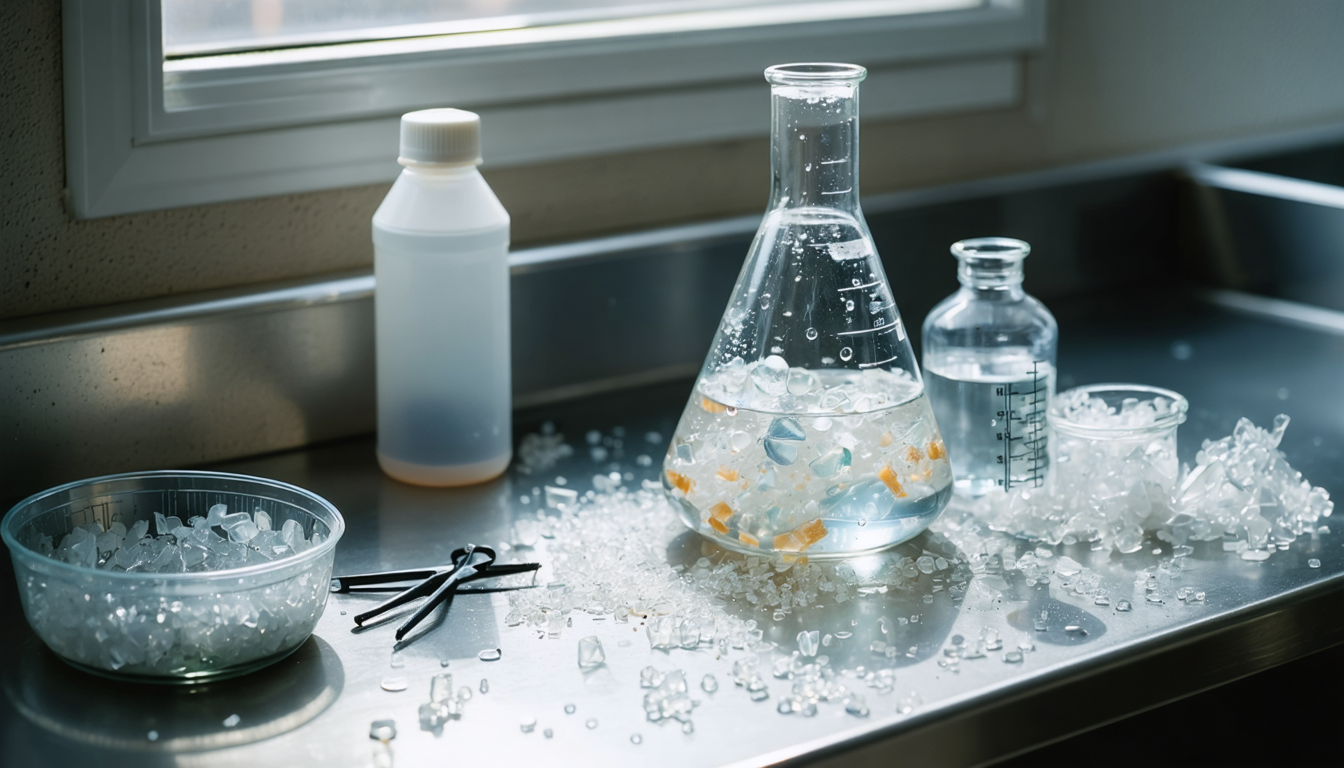
Three key figures: a liter of bottled water held on average some 240,000 detectable plastic fragments, mostly nanoplastics; human blood is approximately 50% water; human cells are generally 60% to 80% water. The blood and cell figures are disputed.
| Figure | Value | Note | Claim |
|---|---|---|---|
| Plastic fragments per liter of bottled water, about | 240,000 fragments | average; mostly nanoplastics | 14 |
| Human blood, water, approx. | 50% | disputed | 13 |
| Water share of a human cell, at least | 60% | disputed; generally 60% to 80% | 13 |
What happened
- Columbia ran the chemical and biological experiments, while Teresa Head-Gordon's lab at UC Berkeley supplied calculations and dynamical simulations of how the plastic interacts with water.
- Head-Gordon's theory showed that hydroxide ions are promoted into the water layers nearest the hydrophobic microplastic interface.
- As plastic fragments into micro- and nanoparticles, its surface area rises sharply relative to its volume, exposing far more material to the surrounding water.
- A 2024 study led by Min's Columbia group counted some 240,000 detectable plastic fragments per liter of bottled water, mostly nanoplastics.
Why it matters
- What doesn't add up contradiction Plastic is used for food packaging, water bottles and toys because it is presumed inert. The authors say that presumption fails once the material breaks into micro- and nanoparticles.
- Who's exposed exposure The authors suggest particles that reach the bloodstream or cells could stay chemically active there, since blood is about 50% water and cells 60% to 80%.
- What it limits constraint The earlier health findings are associations. A plausible pathway makes them easier to interpret but does not by itself show cause in people.
Next story · Science · 5h ago
Baker lab's from-scratch zinc proteases cut their chosen target in 36% of 135 designsConfirmed2 publishers
Wei Min, the Columbia chemist who co-led the work, put the mechanism in one sentence: "Contact between the water and plastic creates an environment that facilitates electron transfer and the formation of reactive radicals," he said [3]. Naixin Qian, a postdoctoral researcher in Min's lab, described where it happens. When microplastics interact with water, "as they do when they're in bottled water, or when they're absorbed into our bloodstream, they spontaneously generate what we call reactive oxygen species (ROS)," she said [1]. ROS, Qian said, "are textbook examples of the kinds of molecules that can damage animal and human tissue" [2].
The paper lands on a gap. Earlier studies in the New England Journal of Medicine, Nature Medicine and Nature Health linked micro- and nanoplastic exposure to heart attack, stroke, dementia and brain tumors, but given the supposed inertness of plastic, the route from material to illness was unclear [7]. The phys.org account says the new study "specifies a previously overlooked mechanism that might help bridge this gap" [8]. Policy has not waited for it: this year the U.S. federal government launched a $144 million program against toxic microplastics in the human body, and the EPA added microplastics to its list of drinking-water contaminants that may pose a concern, a first [15].
In our view the chemistry half of the paper is the sturdier one. A radical-forming interface is something a lab can measure and a simulation can explain, and the study has both [10]. The harm half is an inference, and Min words it as one: the radicals "very likely contribute to biological damage that we see in animals and potentially in humans as a result of microplastic exposure," he said [12]. That view would change if the biological experiments turn out to rest on doses far above what people meet.
The thing this doesn't tell you is how much reactive oxygen a realistic exposure produces. A dose of reactive species depends on how many particles reach tissue and on how much each one yields. Min's 2024 bottled-water count answers only the first question, and a particle count is not a yield [14]. The phys.org account does not report the plastic types, the doses, or the cell or animal systems used in the biological experiments.
What to watch
- Whether the biological experiments are reported at doses and with plastic types that match what people actually meet in water and food.
- Whether other labs reproduce reactive oxygen species formation at the plastic-water interface with the same particle sizes.
- Whether the federal microplastics program or the EPA drinking-water list starts measuring reactive species, not just particle counts.
Clarity's read
What the record supports and how the coverage leans. The claims behind it follow.
Reality
- Evidence72
- Adoption
- Not scored
- Hype gap+22
- Incentives
- Not scored
- Confidence70
Perspective Coverage
6 publishers- Builder
- Builder 33%
- Operator
- Operator 55%
- Investor
- Investor 12%
Claim ledger
Ranked by verification strength, evidence, and original report placement.
- [1]
Naixin Qian, a postdoctoral researcher in Min's lab, said that when microplastics interact with water, "as they do when they're in bottled water, or when they're absorbed into our bloodstream, they spontaneously generate what we call reactive oxygen species (ROS)."
- [2]
Qian said: "ROS are textbook examples of the kinds of molecules that can damage animal and human tissue."
- [3]
Min said: "Contact between the water and plastic creates an environment that facilitates electron transfer and the formation of reactive radicals."
- [4]
A study by researchers from Columbia University and the University of California, Berkeley found that the newly created surface of fragmented plastic is not necessarily safe and identified the chemical reasons why.
- [5]
The research was published in the journal Nature and challenges the common view of microplastics as largely passive fragments of inert material.
- [6]
When a large piece of plastic fragments into micro- and nanoparticles, its surface area increases dramatically relative to its volume, so vastly more of the material is exposed to its surroundings.
- [7]
Subsequent research in journals including the New England Journal of Medicine, Nature Medicine and Nature Health has found links between micro- and nanoplastic exposure and heart attack, stroke, dementia and brain tumors, but given plastic's supposed inertness the mechanism by which microplastics could contribute to these illnesses had been unclear.
- [8]
The phys.org account says the new study "specifies a previously overlooked mechanism that might help bridge this gap."
- [9]
Plastics are supposed to be chemically inert, which is the reason they are used so frequently to package food, bottle water and create children's toys.
- [10]
The Columbia team conducted the chemical and biological experiments, while collaborators in Teresa Head-Gordon's lab at UC Berkeley created theoretical calculations and dynamical simulations to identify how the microplastic interacted with water.
- [11]
Head-Gordon's lab led theory showing that hydroxide ions are promoted to the immediate water layers near the hydrophobic microplastic interface.
- [12]
Wei Min, a Columbia professor of chemistry and biomedical engineering, said microplastics generate reactive radicals (ROS) "that very likely contribute to biological damage that we see in animals and potentially in humans as a result of microplastic exposure."
- [13]
Human blood is approximately 50% water and individual human cells are generally 60% to 80% water; the new research suggests that microplastics entering the bloodstream or cells could remain chemically active in this water-rich environment.
- [14]
A 2024 study led by Min's group at Columbia, using a laser-based microscope technology, found that a liter of bottled water contained on average some 240,000 detectable plastic fragments, mostly nanoplastics, 10 to 100 times more fragments than previously estimated.
- [15]
This year the U.S. federal government launched a $144 million program to combat toxic microplastics in the human body, and the U.S. Environmental Protection Agency recently added microplastics to a federal list of contaminants that may pose a concern for drinking water, the first time microplastics have appeared on the list.
Sources
6 independent publishers whose own reporting we read for this story.
- arstechnica.comMicroplastics in water aren’t inert and make damaging chemicals on their own
1 article · October 15, 2026
- gizmodo.comMicroplastics Are Chemically Alive and Probably Up to No Good
1 article · October 16, 2026
- nature.comIntrinsic physicochemical activity at microplastic–water interfaces
1 article · October 13, 2026
- newscientist.comMicroplastics may produce harmful molecules if they enter our blood
1 article · October 14, 2026
- phys.orgMicroplastics are chemically active and could cause biological harm
1 article · October 14, 2026
- scientificamerican.comMicroplastics are linked to inflammation—scientists might have finally worked out why
1 article · October 14, 2026
Topics and entities
Topics
- Reactive oxygen species
- Microplastics
- Environmental health
- Interfacial chemistry
Entities
- Teresa Head-Gordon
- University of California, Berkeley
- Nature
- Columbia University