Nuri spaces five NEONSAT satellites seconds apart to start Korea's first home-launched constellation
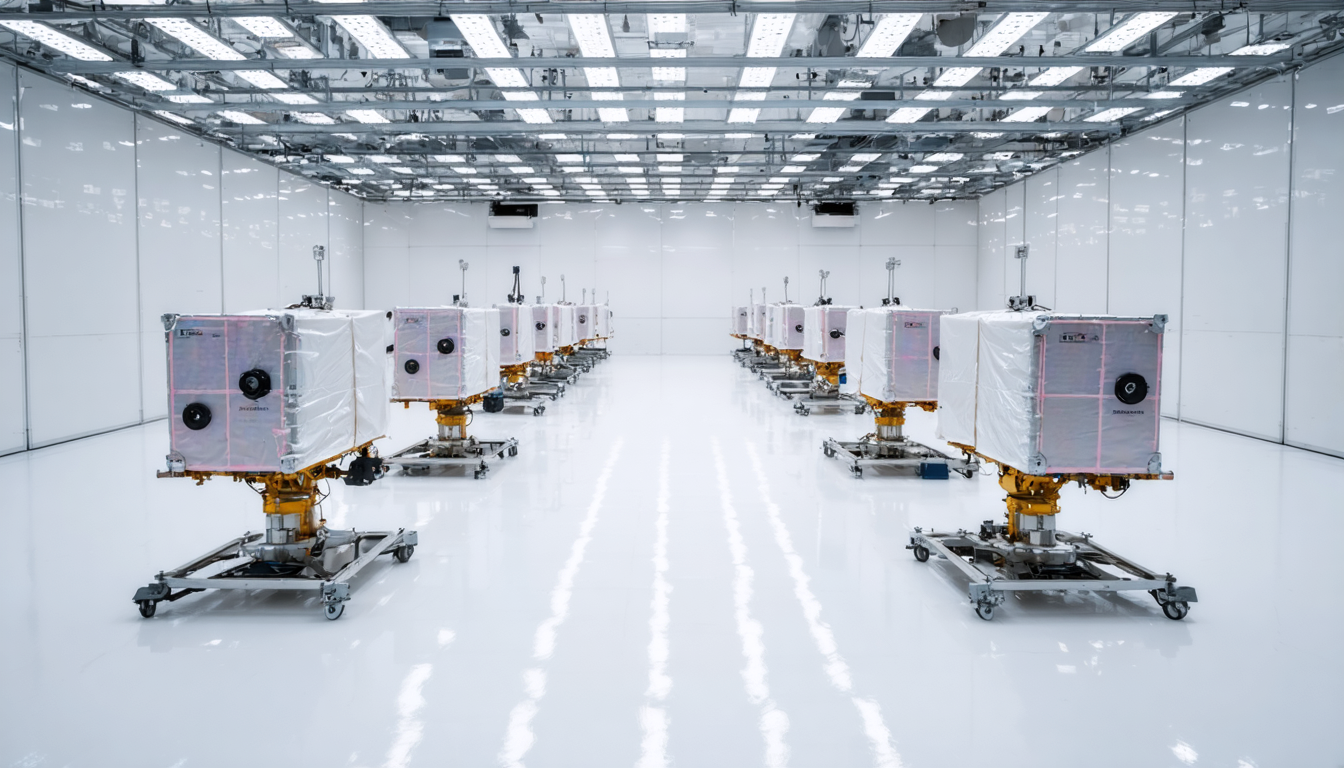
Korea's Nuri rocket placed 15 satellites at about 575 km on its fifth flight, five of them the first home-launched NEONSAT Earth-observation microsatellites. The other half of the 10-satellite constellation, and the coverage it was designed for, waits on a sixth flight next year.
The Investor · Invest desk
What happened
- The flight was Nuri's first attempt to release several primary satellites built for the same mission one after another, according to Yonhap.
- Each NEONSAT weighs under 100 kg and carries a camera that resolves 1 m objects in black-and-white and 4 m in colour, for national security and disaster monitoring.
- Liftoff came at 12:25 p.m. from the Naro Space Center's second pad, the first time Nuri has launched at its scheduled time without delay, Seoul Economic Daily reported.
- The 10 CubeSats carried alongside will run experiments on pharmaceuticals and industrial components in space and study space radiation and Earth's magnetic field.
Why it matters
- Who has to decide decision Planners of later Korean constellations can now count Nuri as a flown launch option for sub-100 kg satellites; what they still have to settle is cadence and price.
- Who's exposed exposure NEONSAT's completion now depends on Nuri's launch cadence, so any slip in the sixth flight keeps Korea's security and disaster imaging at half the designed satellite count.
- What it sets up precedent The sixth flight will repeat this release procedure, 35 to 40 seconds between satellites with a turn of the stage at each, and a second clean run would make it a repeatable Nuri service.
Next story · Invest · 3d ago
Nuri's fifth flight gives CubeSat customers a 90% deployment rate from a sample of oneConfirmed2 publishers
Five satellites released 35 to 40 seconds apart leave four gaps, so the NEONSAT part of the release took between 140 and 160 seconds [13]. At each gap the upper stage turned about 45 degrees to keep the satellites from colliding [4], roughly 180 degrees in all between the first separation and the last [15]. The CubeSats went out in pairs every 10 seconds [19], about 40 seconds from first pair to last [20]. Nuri then made a collision-avoidance maneuver and vented its remaining fuel, ending its flight about 20 minutes after liftoff [6].
I think the claim that Korea can now deploy a constellation on its own rocket holds, in a narrow form. Five of a planned ten NEONSATs are in orbit [18] [9], put there with a release sequence Nuri had not flown before [7]. The counter-thesis is scale. Five satellites of under 100 kg each come to less than 500 kg [16], under a quarter of one percent of a 200-ton rocket [17]. The three reports do not give Nuri's rated payload, a launch price or a programme budget. Without them, the cost of a constellation on Nuri, per satellite or per kilogram, cannot be worked out.
The performance the programme was built for, or rather the performance Yonhap attributes to the finished system, needs the full set. Once operational, Yonhap reports, the constellation will image the Korean Peninsula more than three times a day and revisit the same location within 24 hours [10]. Those figures belong to ten satellites. Five are up.
Yonhap's count has one loose end. The satellites deployed are Nos. 2 through 6 [4], and the five on the sixth flight complete a constellation of 10 [9]. Adding a No. 1 to that count would make 11 [14], so either No. 1 sits outside the ten or the count is off by one.
The thesis fails if the sixth flight cannot repeat the sequenced release for the remaining five. That would leave Nuri with one successful multi-satellite deployment and half a constellation. So far the record is one flight: Nuri separated its first and second stages and released the satellites at around 575 km, according to the Korea AeroSpace Administration [2].
What to watch
- KASA's confirmation of initial communications with each of the five NEONSATs, the check the Korea Herald said would come before the official outcome announcement.
- A firm date for Nuri's sixth flight, and whether it again leaves on schedule after this first on-time liftoff.
Information, not investment advice. This story is general information about companies and markets, drawn from cited reporting. It is not a recommendation to buy, sell or hold any security; check the cited sources before acting.
Clarity's read
What the record supports and how the coverage leans. The claims behind it follow.
Reality
- Evidence74
- Adoption35
- Hype gap+15
- Incentives70
- Confidence76
Perspective Coverage
4 publishers- Builder
- Builder 36%
- Operator
- Operator 30%
- Investor
- Investor 34%
Claim ledger
Ranked by verification strength, evidence, and original report placement.
- [1]
The 200-ton Nuri blasted off from the Naro Space Center in Goheung at 12:25 p.m.
- [2]
Nuri successfully separated its first and second stages before releasing the satellites at an altitude of around 575 km, the Korea AeroSpace Administration (KASA) said.
- [3]
The payload consisted of five NEONSAT microsatellites and 10 CubeSats.
- [4]
The five NEONSATs, Nos. 2 through 6, each weighing less than 100 kg, were deployed at intervals of 35 to 40 seconds, with Nuri's upper stage rotating about 45 degrees between each separation to prevent collisions.
- [5]
Nuri lifted off from the second launch pad at the Naro Space Center at 12:25 p.m., the first time the rocket has launched at its scheduled time without delay.
- [6]
After releasing all 15 satellites, Nuri performed a collision-avoidance maneuver and vented its remaining fuel, completing its flight about 20 minutes after liftoff; the stage will remain in orbit before reentering the atmosphere.
- [7]
The fifth flight was Nuri's first attempt to sequentially deploy multiple primary satellites designed to perform the same mission.
- [8]
Each NEONSAT weighs less than 100 kg and carries an electro-optical camera capable of distinguishing objects as small as 1 meter in black-and-white images and 4 meters in color images; the satellites will monitor the Korean Peninsula and surrounding areas for national security and disaster response.
- [9]
The NEONSAT constellation will eventually consist of 10 satellites; another five will be launched aboard Nuri's sixth flight, scheduled for next year, to complete the constellation.
- [10]
Once fully operational, the constellation will be capable of imaging the Korean Peninsula more than three times a day and revisiting the same location within 24 hours.
- [11]
The CubeSats will carry out experiments involving pharmaceuticals and industrial components in space, while also studying space radiation and Earth's magnetic field.
- [12]
Authorities were expected to announce the outcome of the mission at around 2 p.m., after checking the deployment and initial communications of the satellites.
- [13]
The NEONSAT release sequence lasted between 140 and 160 seconds.
- [14]
Satellites Nos. 2 through 6 plus five on the sixth flight make 10; counting a No. 1 as well would make 11.
- [15]
The upper stage rotated roughly 180 degrees in total between the first and last NEONSAT separation.
- [16]
The five NEONSATs together weigh less than 500 kg.
- [17]
The five primary satellites amount to less than a quarter of one percent of the 200-ton rocket's mass.
- [18]
South Korea launched its homegrown Nuri rocket on Wednesday, Oct. 7, on its fifth flight, placing 15 satellites into orbit, including five that will form part of the country's first domestically launched microsatellite constellation.
- [19]
The 10 CubeSats followed in pairs every 10 seconds.
- [20]
The CubeSat pairs took about 40 seconds from first pair to last.
Sources
4 independent publishers whose own reporting we read for this story.
- en.sedaily.comNuri Rocket Lifts Off at 12:25 p.m.
6 articles · October 7, 2026
- en.yna.co.kr(4th LD) S. Korea's Nuri rocket successfully deploys satellites into orbit in 5th mission
6 articles · October 7, 2026
- koreaherald.comNuri rocket lifts off on fifth mission with 15 satellites aboard
2 articles · October 6, 2026
- koreajoongangdaily.comNuri rocket successfully launches with 15 satellites
2 articles · October 7, 2026
Topics and entities
Topics
- Earth observation and satellite monitoring
- Commercial space industry
- Space launch vehicles
- Satellite Constellations
Entities
- Korea AeroSpace Administration
- Naro Space Center
- HD Hyundai Heavy Industries
- Korea Aerospace Research Institute
- Hanwha Aerospace