CT scans of two Wyoming fossils place a new belemnite in a family thought long gone
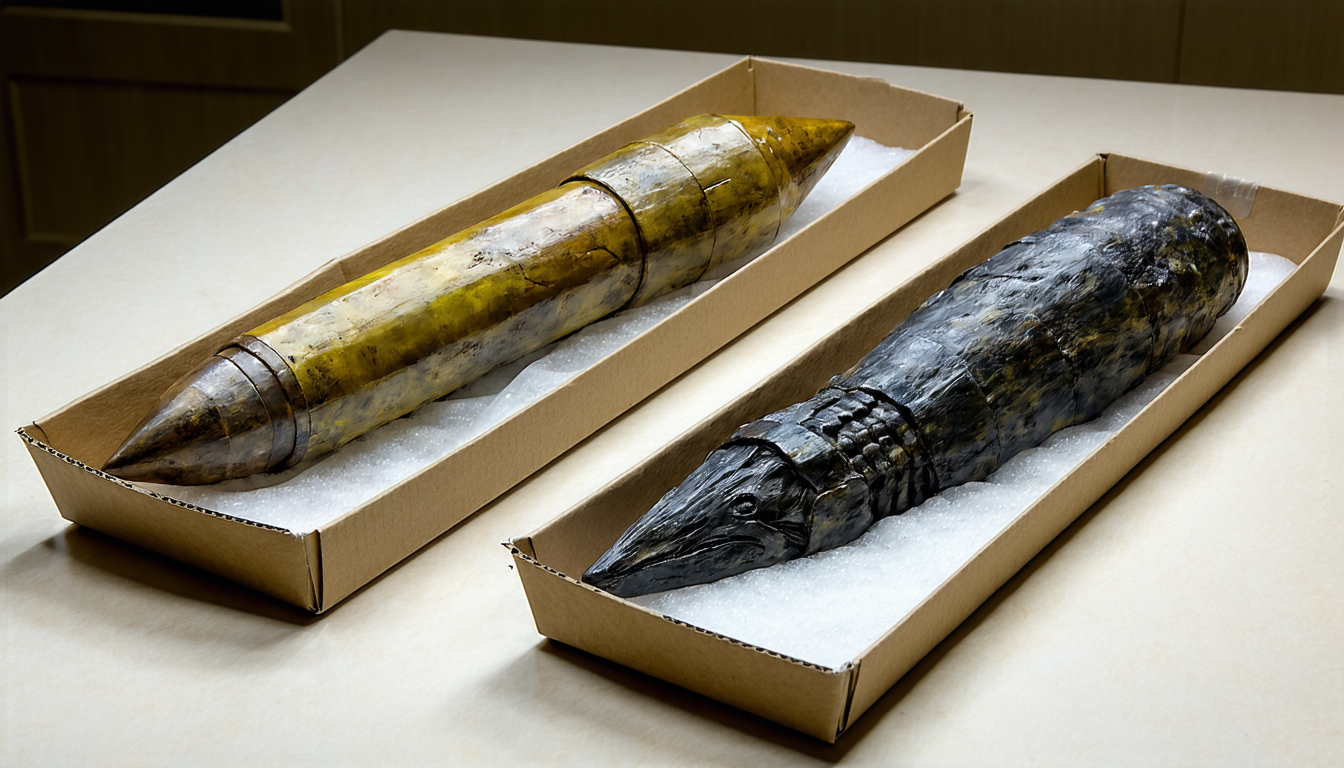
Wyoteuthis linsterorum has a guard up to 6 cm wide where Wyoming's ordinary belemnites manage 1 to 2 cm, a difference in proportion that took two specimens found two decades apart to establish.
The Scientist · Science desk
What happened
- An international team from the United States, United Kingdom and New Zealand described Wyoteuthis linsterorum in Papers in Palaeontology, from two Wyoming fossils dated to about 160 million years ago.
- Its rostrum is about 10 centimetres long but up to 6 centimetres wide, against the 5-to-10 by 1-to-2 centimetre bullets typical of Wyoming belemnites, making it the thickest recorded.
- Wyoming Dinosaur Center founder Burkhard Pohl found the first specimen in the late 1990s, and it stayed unstudied until collector Cliff Linster found a second near Ten Sleep and donated it in 2019.
- Ippolitov, the team's belemnite specialist, said he was deeply surprised, and that after more than 200 years of research on the group a fossil differing this radically is exceptionally rare.
Why it matters
- What's now possible capability Non-destructive imaging is what makes an odd guard describable at all: the diagnostic characters sit inside the fossil, so a museum can now get a family assignment without sacrificing one of only two specimens.
- What it limits constraint With two specimens and no soft tissue, nothing about the animal's abundance, geographic range or diet can be tested, which leaves the size-based hunting explanation as a hypothesis rather than a result.
- Who has to decide decision The limiting resource in this case was specialist attention rather than exposure, which argues for spending curatorial time re-examining old accessions alongside funding new collecting.
- What it sets up precedent A donated amateur find carrying half the type material is an argument for museums keeping that pipeline open, since the specimen that completes a description may already be in private hands.
Next story · Science · 2d ago
A Jurassic bird from Fujian had pheasant-like limbs and a sickle-shaped claw typical of deinonychosaursConfirmed6 publishers
The shape is the whole claim. Ordinary Wyoming belemnite guards run 5 to 10 centimetres long and 1 to 2 wide [5], which is a length-to-width ratio of about five to one. Wyoteuthis, at roughly 10 centimetres by 6 [6], comes in under two to one [18]. Assume a circular cross section and a 6-centimetre guard encloses about nine times the area of a 2-centimetre one [19]. The proportions changed here, not just the size, and that is why the field call was easy: Bill Wahl, who instigated the study, said the fossil stuck out like a sore thumb [14].
The outside oddity is not what settled the taxonomy. CT scanning let the team read internal structure without cutting either specimen, and those internal features placed the animal in an ancient belemnite family previously thought to have disappeared millions of years earlier [1]. This account does not specify which family, or how wide the gap is in millions of years, and that second number is what decides whether the paper reports a modest extension of a known range or a long unsampled interval.
Then the denominator. Millions of belemnite guards have come out of the Sundance Formation, laid down by an inland sea over the western United States [9]. Two of them are Wyoteuthis [3], which puts the recognised frequency on the order of two per million [21]. Collecting bias runs against explaining that away as neglect: a fat barrel is more likely to be picked up than another bullet, and the first specimen was noticed in the late 1990s precisely because it was bigger than anything the finder had seen [11].
Alexey Ippolitov, the belemnite specialist on the team, offers size-based predation as a possible explanation, with the animal taking smaller co-occurring Pachyteuthis and modern squid cannibalism as the behavioural analogy [2]. That is an inference from body size and shared occurrence rather than a measurement. Gut contents or bite damage would test it, and neither is reported. Only a small fraction of the animal is in hand: a 10-centimetre guard from a creature estimated at about 60 centimetres including arms [7] is roughly a sixth of its length [20], and the soft parts that would carry a feeding signal are the part that did not survive.
Specialist attention, not outcrop, was the scarce resource here. The description arrived almost 30 years after the first find [13], and it arrived when a second specimen turned up and a specialist looked [12]. Jessica Lippincott, a co-author, makes the point that people who rockhound or collect invertebrate fossils can contribute to science [17]; the species name linsterorum honours the collector who found the second specimen and his family [15], and he died in June [16]. For a group as heavily collected as belemnites, where Ippolitov says a find this different is exceptionally rare after more than two centuries of work [8], the cheaper place to look for the next unrecognised body plan is a museum drawer rather than a new quarry.
What to watch
- Which belemnite family the paper assigns it to, and how many millions of years the stratigraphic gap actually covers.
- A third specimen with gut contents or bite damage, which would move the predation idea from body-size inference to evidence.
- Whether other Sundance collections turn up misfiled fat guards now that collectors have a published search image.
Clarity's read
What the record supports and how the coverage leans. The claims behind it follow.
Reality
- Evidence60
- Adoption
- Not scored
- Hype gap+5
- Incentives
- Not scored
- Confidence58
Claim ledger
Ranked by verification strength, evidence, and original report placement.
- [1]
Using CT scanning, the team examined the fossils without damaging them, revealing internal features that confirmed the animal belonged to an ancient family of belemnites previously thought to have disappeared millions of years earlier.
- [2]
Ippolitov said a possible explanation is that the animal's relatively large size gave it an advantage when hunting co-occurring smaller belemnites of the genus Pachyteuthis, noting that modern squid readily hunt other cephalopods and sometimes their own kind.
- [3]
A new species of Jurassic belemnite, Wyoteuthis linsterorum, has been named from two exceptionally rare fossils dating to around 160 million years ago found in Wyoming; belemnites are ancient cephalopods, cousins of modern squid and octopus.
- [4]
The discovery was described in the journal Papers in Palaeontology by an international team from the United States, United Kingdom and New Zealand, including Dr Dean Lomax, honorary research fellow at the University of Manchester.
- [5]
Most Wyoming belemnites are bullet-shaped, measuring around 5 to 10 centimetres long and only 1 to 2 centimetres wide.
- [6]
The new species had an unusually broad, barrel-shaped rostrum around 10 centimetres long but up to 6 centimetres wide, making it the thickest belemnite ever recorded.
- [7]
Researchers estimate the living animal would have reached around 60 centimetres in total length, including its arms.
- [8]
Alexey Ippolitov, a belemnite expert now at Victoria University of Wellington, said he was deeply surprised to discover a fossil from such a well-studied group that differed so radically from anything previously known, and that after more than 200 years of palaeontological research on belemnites such discoveries are exceptionally rare.
- [9]
Belemnites are among the most common fossils found worldwide, recognised by their bullet-shaped rostrum or guard, and millions have been discovered in Wyoming's Sundance Formation, an ancient inland sea that once covered the western United States.
- [10]
Co-author and Wyoming palaeontologist Jessica Lippincott said the fossils are nicknamed "squid butts" in Wyoming.
- [11]
The first specimen was unearthed in the late 1990s by Dr Burkhard Pohl, founder of the Wyoming Dinosaur Center, after he spotted a belemnite much bigger than any he had seen before, and it then sat unstudied in the museum's collection drawer for many years.
- [12]
A second specimen was found by fossil collector Cliff Linster near Ten Sleep, Wyoming, and donated to the Wyoming Dinosaur Center in 2019; together the two fossils provided the evidence needed to identify and formally describe the new species.
- [13]
The discovery was almost 30 years in the making.
- [14]
Wyoming palaeontologist and co-author Bill Wahl instigated the work and said this belemnite "stuck out like a sore thumb".
- [15]
Wyoteuthis translates to "a squid from Wyoming", and the species name linsterorum honours Cliff Linster and his family; Linster discovered one of only two known specimens and donated it for scientific study.
- [16]
Linster died in June this year, knowing researchers were studying his discovery and excited to see it formally described.
- [17]
Lippincott said the fossil is unlike anything she has seen after years of collecting the common Pachyteuthis belemnites in Wyoming, and that it shows new fossil species are still being found and that people who rockhound or collect invertebrate fossils can also contribute to science.
- [18]
Typical Wyoming belemnite guards have a length-to-width ratio of about five to one, while the new species is under two to one.
- [19]
Assuming a circular cross section, a 6-centimetre-wide guard encloses about nine times the cross-sectional area of a 2-centimetre-wide one.
- [20]
The preserved 10-centimetre rostrum is about one sixth of the animal's estimated 60-centimetre total length.
- [21]
With two known specimens against millions of belemnites collected from the Sundance Formation, the recognised frequency of the new species is on the order of two per million.
Sources
2 independent publishers whose own reporting we read for this story.
- discovermagazine.com160-Million-Year-Old ‘Squid Butt’ Fossil Is the Chunkiest Belemnite Ever Found
1 article · September 10, 2026
- phys.org'Peculiar' new species of Jurassic squid found in Wyoming
1 article · September 10, 2026
Topics and entities
Topics
- Amateur fossil collecting
- Paleontology
Entities
- Wyoming Dinosaur Center
- Papers in Palaeontology
- Sundance Formation
- Jessica Lippincott
- Victoria University of Wellington
- Alexey Ippolitov
- Wyoteuthis linsterorum