Pines planted where pines never grew break the growth-versus-drought tradeoff
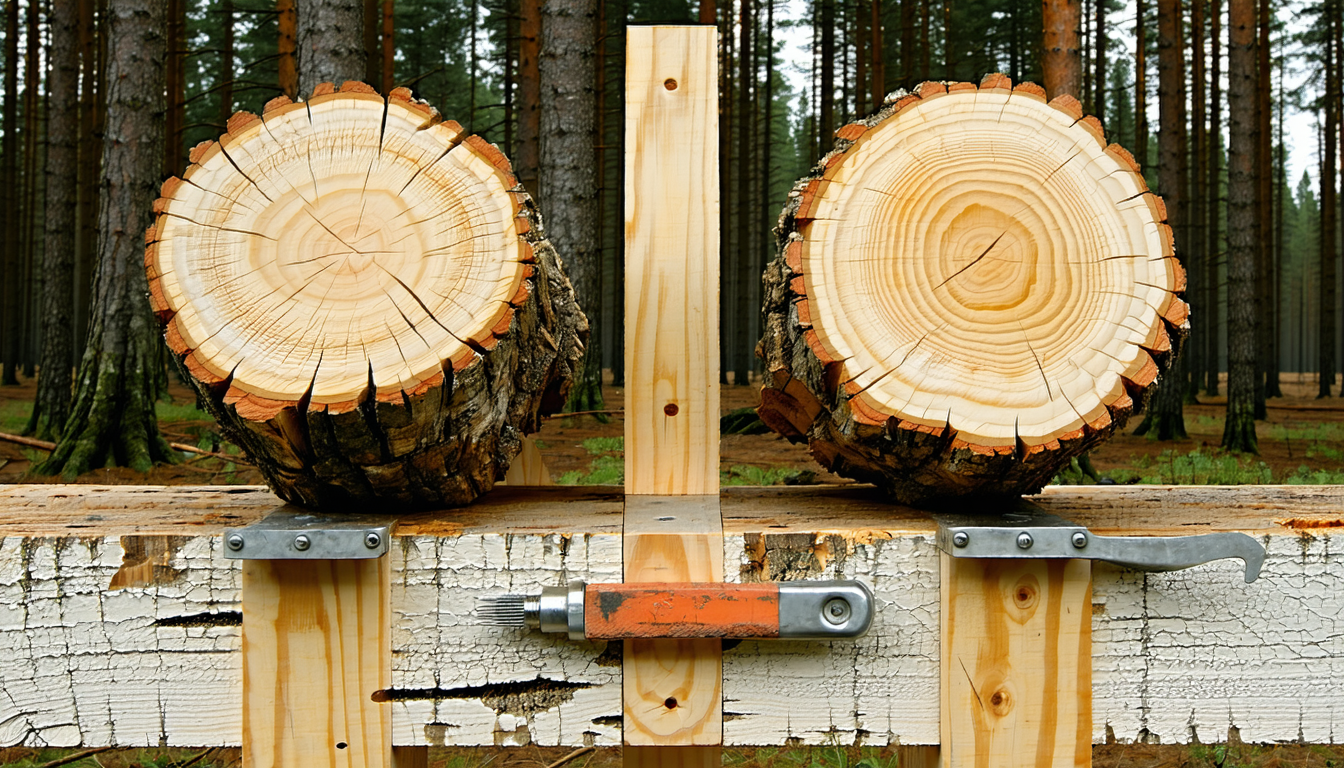
A standardized tree-ring survey at 192 sites finds the same nine pine species growing up to four times faster in southern plantations than in their native northern stands, while losing less growth to drought.
The Scientist · Science desk
What happened
- A Nature tree-ring study reports that Northern Hemisphere conifers planted in the Southern Hemisphere grow up to four times faster than conspecifics still standing in their native ranges.
- The survey covered nine Pinaceae species, among them radiata, ponderosa, lodgepole and Scots pine, at sites spread across the Americas, Europe, Africa and Oceania.
- Trees in non-native ranges carried more non-structural carbohydrate and lower carbon-isotope ratios, which the authors read together with faster stem growth as higher net carbon assimilation.
- Fajardo's preferred explanation is escape from specialized herbivores, pathogens and competing species that are present or more abundant back in the native range.
Why it matters
- What it limits constraint Vegetation and forestry models that treat fast growth as something bought with reduced stress tolerance will misjudge exactly the stands where the assumption fails, and those stands are planted at large scale.
- Who has to decide decision Anyone crediting afforestation as a carbon sink now has to decide whether to use native-range growth and drought behaviour as the baseline, a question the authors flag as open rather than settled.
- Who's exposed exposure Fast growth combined with drought tolerance is also the trait pair that makes a woody invader effective, and the paper's own reference list carries prior work on introduced conifers spreading in South America and into treeless ecosystems.
Next story · Science · 5h ago
Baker lab's from-scratch zinc proteases cut their chosen target in 36% of 135 designsConfirmed2 publishers
Start with what makes this a test rather than an observation. Species identity is held constant and hemisphere is varied: the same nine taxa across 192 sites, all sampled under one standardized dendrochronological protocol [4]. That design is why a fourfold gap is interesting at all, because a single plantation growing fast in Chile could just be a good site.
The asymmetry sits in the sampling. Collaborators in the United States, Canada and Europe cored natural populations of the same pines [12]; the southern material is plantation. Planted stands differ from wild ones in more than the absence of enemies, and ring width alone cannot separate enemy escape from site choice, spacing or planting stock. Alex Fajardo, who led the work from the Institute of Ecology and Biodiversity and the University of Talca [10], puts enemy release first [8], and the argument is economical: defence is expensive, and in a hemisphere with no native pines the specialists never followed [14][9]. The measured physiology is consistent with that [6][13]. Consistency of this kind narrows the field of explanations without closing it.
The isotope result matters most here. Lower carbon-isotope ratios point to weaker stomatal limitation on photosynthesis [7], which is the water-spending end of the gas-exchange spectrum and usually the profile of a tree that suffers in dry years. Here it arrives alongside smaller drought losses and faster recovery [2]. If the authors' carbon-balance reading holds [13], the resolution is that assimilation is high enough to fund the wood and the storage at the same time.
Ring-width surveys have a limit here: they cannot show who died. Increment cores come from standing trees [11], so resistance and resilience indices are computed on survivors in both hemispheres, and mortality is the concern the paper opens on [15]. "Up to four times" is a ceiling rather than a central estimate; nine species across 192 sites averages roughly 21 sites per species [18], and the abstract does not report how the growth ratios distribute across species or continents.
One question remains unanswered. Teams in Chile, Argentina and New Zealand also cored Nothofagus growing next to the pine plantations [17], and the phys.org account stops mid-sentence before reporting what those native trees showed [20]. My reading, held conditional on that species-level breakdown: the growth-versus-tolerance tradeoff looks less like a physiological law than a regularity of trees living where their enemies live.
What to watch
- The full paper's species-by-species and site-level breakdown behind the fourfold figure, which the abstract does not give.
- What the Nothofagus cores taken beside plantations in Chile, Argentina and New Zealand show about the neighbouring native trees.
- Any mortality data, rather than ring-width indices from surviving trees, comparing the same species in planted and native stands.
Clarity's read
What the record supports and how the coverage leans. The claims behind it follow.
Reality
- Evidence68
- Adoption
- Not scored
- Hype gap+15
- Incentives
- Not scored
- Confidence60
Claim ledger
Ranked by verification strength, evidence, and original report placement.
- [1]
A study published in Nature reports that conifers native to the Northern Hemisphere and planted outside their native range in the Southern Hemisphere grow up to four times faster than conspecifics in native ranges.
- [2]
The same non-native southern populations were more resistant and more resilient to drought than conspecifics in native ranges, meaning growth was less affected during droughts and recovery afterwards was greater.
- [3]
The finding challenges the long-standing idea in plant ecology that rapidly growing plants generally have a lower capacity to tolerate water stress.
- [4]
The result comes from a standardized dendrochronological survey at 192 sites across four continents.
- [5]
The team analysed growth rings of nine conifer species in the Pinaceae family, all native to the Northern Hemisphere, including radiata pine, ponderosa pine, lodgepole pine and Scots pine, at sites across the Americas, Europe, Africa and Oceania.
- [6]
Conifers in non-native ranges had higher concentrations of non-structural carbohydrates, which are commonly associated with drought tolerance.
- [7]
Conifers in non-native ranges had lower d13C values, consistent with lower stomatal limitations on photosynthesis.
- [8]
Fajardo says the most likely explanation for the pattern is that exotic conifers escape their natural enemies, which are present or more abundant in the native range, including specialized herbivores, pathogens and competing species.
- [9]
Fajardo says resources that plants in their native range must allocate to defending themselves against natural enemies could, in an exotic range, become available for other functions such as growth and better coping with water stress.
- [10]
The research was led by Dr Alex Fajardo of the Institute of Ecology and Biodiversity (IEB) and the University of Talca, with Dr Frida I. Piper (IEB, University of Talca) and Dr Claudia Reyes-Bahamonde (LiLi Millennium Nucleus, University of Talca), plus a collaborating network of researchers from 10 countries.
- [11]
Increment cores were extracted from the trees to determine annual growth-ring widths, which are closely related to climate.
- [12]
Collaborators in the United States, Canada and Europe conducted their sampling in natural populations of the same pine species.
- [13]
The authors state that higher non-structural carbohydrate concentrations, lower d13C values and higher stem growth rates all point towards higher net carbon assimilation by conifers in non-native ranges.
- [14]
There are no native pine species in the Southern Hemisphere.
- [15]
The paper frames drought-induced conifer mortality as a global concern and notes that Northern Hemisphere conifers planted at massive scales in the Southern Hemisphere do not appear to show the same magnitude of growth decline or mortality as in their native ranges.
- [16]
The authors say the paradoxical combination of high growth rates yet drought resilience emphasizes the importance of integrating eco-evolutionary history into ecological theory and is relevant for assessing the ultimate role of afforestation as global carbon sinks.
- [17]
In the Southern Hemisphere, particularly in Chile, Argentina and New Zealand, increment cores were also extracted from trees of Nothofagus species growing adjacent to pine plantations.
- [18]
Nine species distributed over 192 sites is an average of about 21 sites per species; the abstract does not report how sites or growth ratios are split across species.
- [19]
The paper's reference list includes Simberloff et al. (2010) on the spread and impact of introduced conifers in South America and Moyano et al. (2024) on unintended consequences of planting native and non-native trees in treeless ecosystems.
- [20]
The phys.org article's text ends mid-sentence in a section headed 'The case of Chile and native forests', before reporting what the researchers observed for native species growing adjacent to plantations.
Sources
2 independent publishers whose own reporting we read for this story.
- nature.comPines grow faster and are more drought resilient in the Southern Hemisphere
1 article · September 1, 2026
- phys.orgExotic pines in the Southern Hemisphere grow faster and are more drought-resistant, study reveals
1 article · September 2, 2026
Topics and entities
Topics
- Tree-ring science
- Forest drought resilience
- Afforestation and carbon sequestration
- Enemy release hypothesis
- Non-native tree species
Entities
- University of Talca
- Claudia Reyes-Bahamonde
- Institute of Ecology and Biodiversity
- Nature