Archaeologists date a Kekova Island wreck to 4,400-4,700 years by its pottery
Archaeologists say a 10m trade ship wrecked off Kekova Island, Turkey, is the oldest known shipwreck, at 4,400 to 4,700 years old. No wood survived for radiocarbon testing, so the date rests on amphora style, and residue in the jars may come from reuse.
The Scientist · Science desk
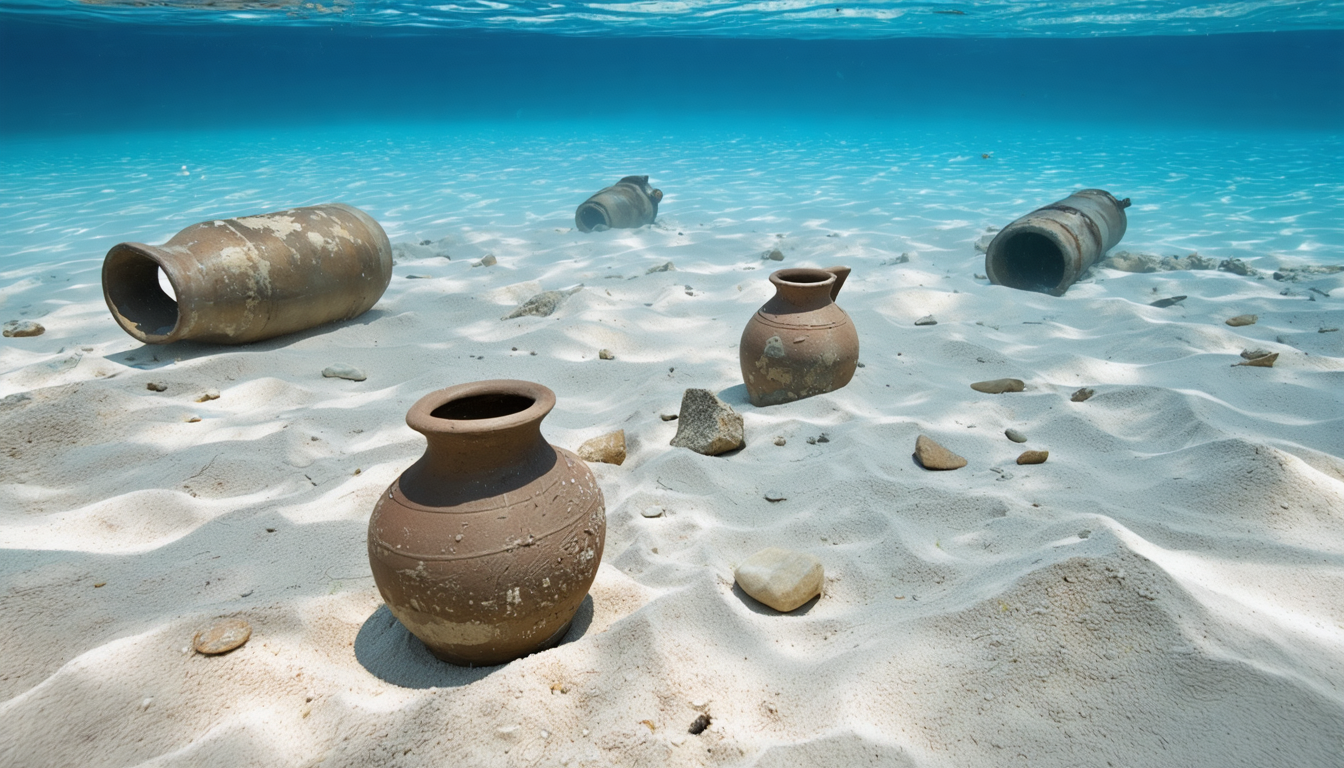
Kekova Island wreck: at least 4,400 years old, up to 4,700, per archaeologists. Dokos wreck in Greece, the previous record holder: about 4,200 years ago, disputed. Oldest known shipwreck with some wood preserved, off Bulgaria: about 2,400 years ago.
| Figure | Value | Note | Claim |
|---|---|---|---|
| Kekova wreck age, at least, per archaeologists | 4,400 years old | up to 4,700 years old | 14 |
| Dokos, previous record | 4,200 years ago, about | disputed | 18 |
| Oldest wreck with wood | 2,400 years ago, about | 12 |
What happened
- The wreck lies about 30m down on an underwater slope close to the shore of Kekova Island in Antalya, with artefacts scattered across it.
- Divers found three large stone anchors and more than 30 ceramic storage pots called amphorae.
- The amphorae have two handles, a ridge in the middle and a flat base, a design expedition leader Hakan Öniz says matches pots from Egypt and the Middle East.
- Some recovered jars are intact and still hold a viscous, glossy residue, which Macquarie University's Karin Sowada examined after they were raised.
- The archaeologists say the ship started on the eastern Mediterranean coast and believe it was bound for Troy or for the Minoans on Crete.
Why it matters
- What it limits constraint With radiocarbon ruled out, the age is only as sharp as the pottery comparison, which here spans a 300-year window.
- What doesn't add up contradiction The residue is the hook for learning what was traded, yet the archaeologist examining it says reuse of the jars could explain it.
- What's now possible capability The wood is gone, so the contents of the jars are the organic material available to test, and some jars hold plenty of it.
Next story · Science · 2d ago
Divers find more than 20 stone artefacts at two submerged sites off MurujugaConfirmed2 publishers
No timber survived, so the usual clock was out of reach. Radiocarbon dating measures a form of carbon in organic material, and the wreck had none left to measure [1]. The team read the pottery instead, on the principle that styles change over time and so mark periods [4].
Prof Hakan Öniz of Akdeniz University, who led the Mediterranean Archaeology Association expedition [10], is unhedged about the result. Of the comparison with decorated pots, he said "we can definitely say our wreck is Early Bronze Age. This is 100%." [3]
A style match is a comparison with other objects, so the wreck inherits whatever uncertainty sits in the dates of the reference amphorae. The thing this doesn't tell you is how those reference pots were dated. The BBC report calls them known to be 4,400-4,700 years old and does not cite a published paper.
The record claim is safer than the date. The previous holder, a wreck off Dokos in southern Greece, dates to about 4,200 years ago [18]. Even the young end of the Kekova range is 200 years older than that, and the old end is 500 [19]. The oldest wreck with wood still preserved is a separate record: it lies in the Black Sea off Bulgaria and dates to about 2,400 years ago [12].
The residue is a harder inference. Karin Sowada, who examined the jars after divers raised them, said: "I looked inside and nearly fainted." [9] The team is now working to establish what the jars held [8]. Her shortlist was short: "It could be olive oil, it could be wine, it could be tree resins," Sowada said [6]. Then she added a caution about the jars themselves. She said the residue could be the result of reuse of the jars: "People would have emptied these jars on arrival and potentially used them for many, many, many years." [7]
In our view the age claim is the sturdier of the two. A style match to well-dated pots places a wreck in a period, and the margin over Dokos holds across the whole Kekova range [19]. The cargo claim needs more. A chemical result will say what a jar held at some point, and only the context of the find can say whether that was the last load aboard.
What to watch
- A published paper that sets out the reference amphorae and how they were dated.
- Residue results from the Kekova jars: olive oil, wine, tree resin, or something else.
- Any evidence that separates a final cargo from decades of reuse of the same jars.
Clarity's read
What the record supports and how the coverage leans. The claims behind it follow.
Reality
- Evidence50
- Adoption
- Not scored
- Hype gap+35
- Incentives
- Not scored
- Confidence60
Perspective Coverage
5 publishers- Builder
- Builder 26%
- Operator
- Operator 46%
- Investor
- Investor 28%
Claim ledger
Ranked by verification strength, evidence, and original report placement.
- [1]
Because none of the ship's wood remained, radiocarbon dating, which measures a form of carbon in organic materials, could not be used; archaeologists analysed the shape of the amphorae instead.
- [2]
The Kekova ceramics have two handles, a ridge in the middle and a flat base; Hakan Öniz said the design matched other amphorae unearthed in Egypt and the Middle East that were known to be 4,400-4,700 years old.
- [3]
Öniz said: "we can definitely say our wreck is Early Bronze Age. This is 100%."
- [4]
Because pottery styles have changed over time, different styles are linked to particular periods.
- [5]
Karin Sowada of Macquarie University, Australia, examined the amphorae after they were recovered; some were intact and still contained a viscous, glossy residue.
- [6]
Sowada said: "It could be olive oil, it could be wine, it could be tree resins."
- [7]
Sowada said: "It's possible that [the residue] could actually be the result of reuse of the jars" and "People would have emptied these jars on arrival and potentially used them for many, many, many years."
- [8]
The team is now working to find out exactly what was being carried in the amphorae.
- [9]
Sowada said: "I looked inside and nearly fainted."
- [10]
Prof Hakan Öniz, from Akdeniz University in Turkey, led the Mediterranean Archaeology Association expedition.
- [11]
The dating range spans 300 years.
- [12]
The oldest known shipwreck where some of the wood is preserved was found in the Black Sea off Bulgaria and dates to about 2,400 years ago.
- [13]
Archaeologists say the world's oldest shipwreck has been discovered off the coast of Turkey.
- [14]
The wreck is dated to between 4,400 and 4,700 years old, the Early Bronze Age.
- [15]
The ship's wooden structure has not survived, but its ceramic storage pots lay on the sea floor and some still contain traces of what they held.
- [16]
The wreck is close to the shore of Kekova Island in Antalya, Turkey, with artefacts scattered across an underwater slope 30m beneath the waves.
- [17]
Divers found three large stone anchors and more than 30 ceramic storage pots called amphorae.
- [18]
The previous record holder was a wreck off Dokos, an island in southern Greece, dated to about 4,200 years ago.
- [19]
The Kekova range is 200 to 500 years older than the Dokos wreck's roughly 4,200 years.
- [20]
The archaeologists say the ship was about 10m long and was a trade vessel carrying cargo across the Mediterranean.
- [21]
The archaeologists say the ship started from somewhere along the eastern coast of the Mediterranean and believe it was taking goods to either Troy or the Minoan people in Crete.
Sources
5 independent publishers whose own reporting we read for this story.
- bbc.co.ukWorld's oldest shipwreck found off coast of Turkey
1 article · October 13, 2026
- discovermagazine.comA 4,700-Year-Old Shipwreck Hailed as the World’s Oldest May Have Carried Goats and Been Bound for Troy
1 article · October 14, 2026
- mezha.netБіля Туреччини знайшли затонулий корабель віком 4,700 років, кажуть дослідники
1 article · October 14, 2026
- newscientist.comAncient shipwreck discovered off Turkey claimed to be world’s oldest
1 article · October 14, 2026
- scientificamerican.comScientists discover an ancient shipwreck dating to when the Great Pyramid was built
1 article · October 15, 2026
Topics and entities
Topics
- Underwater archaeology
- Bronze Age Mediterranean trade
- Archaeological dating
Entities
- Mehmet Nuri Ersoy
- Akdeniz University