Reflection's 501B-parameter Beam coding model launches on SageMaker JumpStart
Reflection AI's Beam coding model computes 23B parameters per token but keeps all 501B in memory, according to AWS and Hugging Face. Self-hosting it starts from a roughly 1 TB BF16 checkpoint and multi-GPU sharding.
The Engineer · Build desk
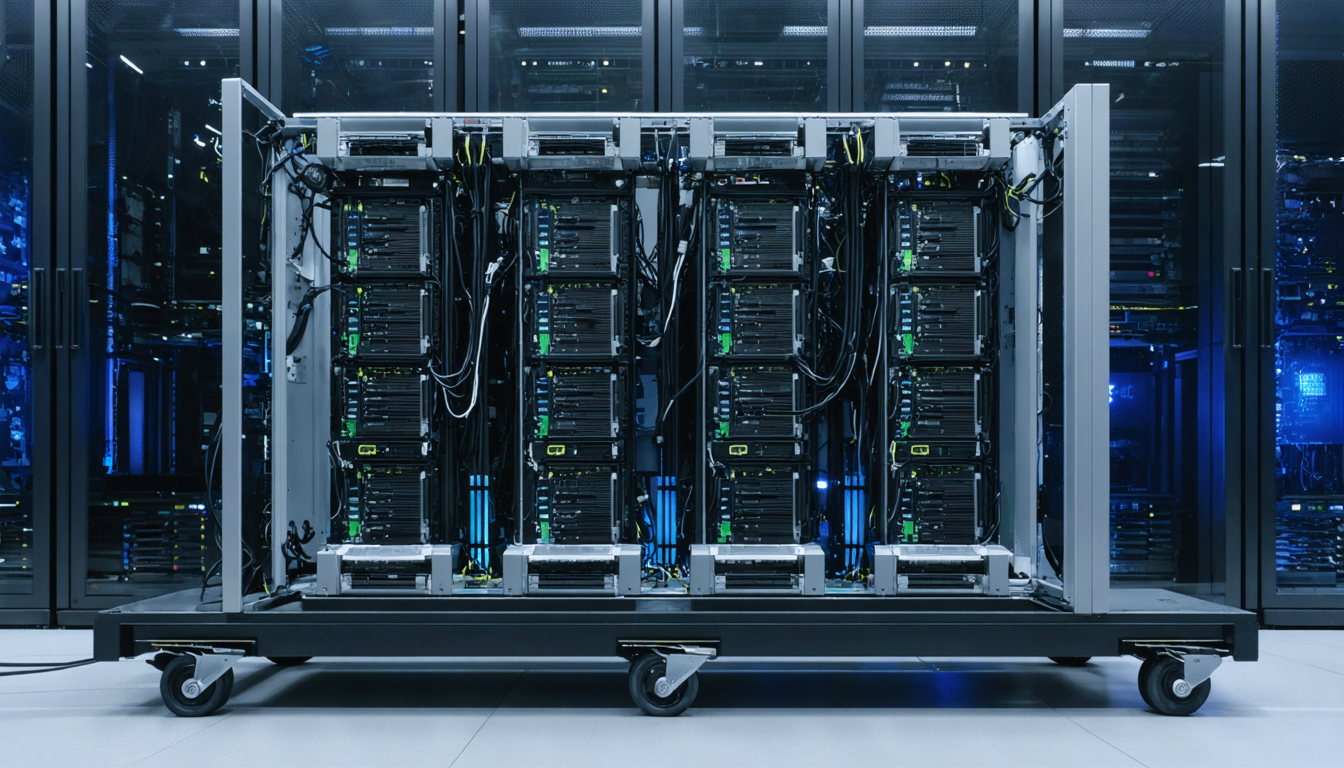
Key figures: Beam has 23 billion active parameters; Hugging Face says deployment needs the memory of a 501 billion parameter model because all experts stay in memory; the BF16 checkpoint is about 1 TB.
| Figure | Value | Note | Claim |
|---|---|---|---|
| Active parameters, sparse mixture-of-experts | 23 billion | 2 | |
| In memory, per Hugging Face | 501 billion | 5 | |
| BF16 checkpoint, about | 1 TB | 4 |
What happened
- At launch, Beam is available in SageMaker JumpStart in US East (N. Virginia) and US East (Ohio).
- Reflection publishes the weights on Hugging Face under Apache 2.0, in BF16, FP8 and NVFP4 checkpoint variants.
- AWS maps FP8 to H100 or H200 instances (ml.p5, p5e, p5en) and NVFP4 to ml.p6-b200.48xlarge with B200 GPUs.
- Beam has 52 layers, 256 experts per MoE layer and 8 routed per token.
Why it matters
- What it costs cost The accelerator count is set by 501B parameters of weights, and the 23B active figure only sets per-token compute.
- What it limits constraint Quota decides the format: a team with only H100 or H200 capacity is limited to FP8, or to BF16 spread across several nodes.
- Who has to decide decision Teams must decide up front whether they need runtime control, because changing quantization or distributed layout means leaving the managed endpoint for HyperPod and Kubernetes.
- What's now possible capability Apache 2.0 weights with SFT and RL recipes let a team post-train Beam on its own repositories.
Hugging Face states the serving cost in one sentence: "All 256 experts stay in memory, so deployment needs the memory of a 501B model but runs at the speed of a 23B one." [5] Per token, 8 of the 256 experts run [10]. That is 3.1% of them [26]. The active parameters are 4.6% of the total [25].
Storage comes first. BF16 uses two bytes per parameter, so 501B parameters come to about 1.0 TB [23]. That matches Hugging Face's figure of about 1 TB in safetensors [4]. AWS says BF16 has the largest weight-memory requirement and calls for a multi-node configuration [8]. FP8 would be roughly 500 GB if each parameter takes one byte [24]. That is our estimate. NVFP4 stores most parameters in 4-bit for Blackwell GPUs and keeps some in BF16 for accuracy [20].
The checkpoint can come from JumpStart, the Hugging Face Hub or an optional S3 mirror [16]. We'd use the mirror for any cluster that restarts workers often, since each restart reloads weights of that size.
Sharding is next. The experts hold 98.4% of the parameters [11], so how a runtime spreads them across GPUs decides most of the memory layout. The router scores 256 experts, splits them into 8 groups of 32, keeps the 4 best groups and picks the top 8 experts inside them. Beam has no shared expert [18]. If a runtime maps groups to devices, a token touches at most 4 device groups. We'd expect that to bound cross-GPU traffic. It is an inference from the routing scheme, not a measured result.
KV cache is where the attention design matters. Of 52 layers, 43 use sliding-window attention over the previous 512 tokens and 9 attend to the full context [12]. Those 9 are 17.3% of the layers [27]. We think only they grow their KV cache with context length, because the other 43 look back 512 tokens.
Reflection reports an effective context length of 1 million tokens [6]. For that number to transfer to your cluster, the cache for those 9 layers at your batch size has to fit beside the weights. AWS's checklist puts KV cache, context length and batching next to checkpoint storage and weight memory [13]. It tells teams to set concurrency and latency targets, then tune replicas, caching, routing and autoscaling from measured behavior [19].
The path choice follows from that. The JumpStart real-time endpoint bundles the model, container and invocation API with no Kubernetes to operate. SGLang or vLLM on HyperPod Inference exposes the serving image, runtime arguments, quantization and distributed execution [15]. Hugging Face says it worked with Reflection on inference, SFT and RL recipes, with day-0 support in transformers, SGLang and vLLM [17]. AWS lists GPU quota and capacity among the prerequisites [21].
What to watch
- Whether AWS or Reflection publishes throughput and latency per instance type, which would replace the sizing checklist with numbers.
- Whether JumpStart availability extends beyond US East (N. Virginia) and US East (Ohio).
- Community quantizations entered for Reflection's $10,000 Hub credits, which could add checkpoints for other hardware.
Clarity's read
What the record supports and how the coverage leans. The claims behind it follow.
Reality
- Evidence50
- Adoption
- Not scored
- Hype gap
- Not scored
- Incentives60
- Confidence65
Claim ledger
Ranked by verification strength, evidence, and original report placement.
- [1]
Reflection AI introduced Beam, an open-weight model for agentic coding and long-horizon tasks such as maintaining code, using tools, interpreting results, and completing multi-step workflows.
- [2]
Beam is a sparse mixture-of-experts model with 501 billion total parameters and 23 billion active parameters.
- [3]
Reflection releases Beam's weights through Hugging Face under the Apache 2.0 license, and Beam 1.0 is available in BF16, FP8, and NVFP4 checkpoint variants.
- [4]
The BF16 checkpoint is about 1 TB in safetensors format.
- [5]
Hugging Face wrote: "All 256 experts stay in memory, so deployment needs the memory of a 501B model but runs at the speed of a 23B one."
- [6]
Reflection reports an effective context length of 1 million tokens for Beam.
- [7]
At launch, Beam is available in Amazon SageMaker JumpStart in US East (N. Virginia) and US East (Ohio).
- [8]
BF16 has the largest weight-memory requirement, so AWS says to plan a multi-node configuration with enough aggregate GPU memory for the weights and runtime overhead.
- [9]
For FP8, AWS says to use ml.p5.48xlarge with NVIDIA H100 GPUs or ml.p5e.48xlarge and ml.p5en.48xlarge with H200 GPUs; for NVFP4, use ml.p6-b200.48xlarge with NVIDIA B200 GPUs.
- [10]
Beam has 52 layers, with 256 experts per MoE layer and 8 routed per token.
- [11]
The experts hold 98.4% of the model's parameters; the first 3 layers use a dense SwiGLU MLP and the other 49 use a Mixture-of-Experts block of 256 experts.
- [12]
Most layers use sliding-window attention over the previous 512 tokens; every sixth layer and the last one attend to the full context, giving 43 sliding-window layers and 9 global ones.
- [13]
AWS says to size the deployment for checkpoint storage, weight memory, KV cache, context length, batching, runtime overhead, and the supported parallelism.
- [14]
AWS offers a SageMaker JumpStart real-time endpoint as the fully managed path, and SageMaker HyperPod Inference with JumpStart, SGLang, or vLLM for Kubernetes-native control over distributed GPU infrastructure.
- [15]
A JumpStart real-time endpoint gives an AWS managed model package, endpoint, and invocation API without operating Kubernetes; SGLang or vLLM on HyperPod Inference is for when you need to control the serving image, runtime arguments, quantization, or distributed execution.
- [16]
Beam can be sourced through SageMaker JumpStart, Hugging Face Hub, or an optional Amazon S3 mirror.
- [17]
Hugging Face says it worked with the Reflection team on inference, SFT and RL recipes, with day-0 support in transformers, SGLang and vLLM, and full-parameter RL with Miles.
- [18]
Beam's router scores all 256 experts with a sigmoid, splits them into 8 groups of 32, keeps the 4 best groups, then picks the top 8 experts inside them; it uses the same group sizes as DeepSeek-V3 but no shared expert.
- [19]
AWS says to define expected concurrency and latency targets, then configure replicas, caching, routing, and autoscaling from measured workload behavior.
- [20]
The NVFP4 checkpoint stores most parameters in 4-bit precision for NVIDIA Blackwell GPUs, with some parameters kept in BF16 for accuracy.
- [21]
AWS lists GPU quota and capacity for a supported Beam configuration among the prerequisites.
- [22]
Reflection is going to give out $10,000 Hub credits to the best projects that use Beam, including projects that quantize it for other hardware.
- [23]
At two bytes per parameter, 501B BF16 parameters come to about 1.0 TB, consistent with the roughly 1 TB checkpoint Hugging Face reports.
- [24]
FP8 weights would be roughly 500 GB if every parameter takes one byte; this is an estimate, not a published size.
- [25]
Active parameters are about 4.6% of the total.
- [26]
Eight of 256 experts per token is 3.1% of the experts.
- [27]
Nine global-attention layers out of 52 is about 17.3% of the layers.
Get this ledger inside ChatGPT. Ask about any of our stories and the answer brings its figure, each claim’s verdict and the sources. Free, no account.
Sources
2 independent publishers whose own reporting we read for this story.
- aws.amazon.comIntroducing Reflection Beam: an open-weight model for agentic coding on AWS
1 article · October 16, 2026
- huggingface.coWelcome Beam: a 501B open model you can own, customize, and scale
1 article · October 15, 2026
Topics and entities
Follow any of these and your For You feed starts watching them — no settings page required.