Scanning 3D X-ray diffraction finds a textbook cuprate is a patchwork inside
A Warwick-led team imaged the interior of a 214 cuprate crystal at the European Synchrotron Radiation Facility and found two slightly different atomic arrangements. The boundaries between them are hundreds of times wider than expected.
The Scientist · Science desk
What happened
- Chemists at the University of Warwick, working with the European Synchrotron Radiation Facility, used scanning 3D X-ray diffraction to build a picture of a cuprate crystal's interior for the first time.
- Most theories of how cuprates carry current without resistance have assumed for 40 years that the crystal structure is the same all the way through the sample.
- The team believes the same hidden structure is likely common across the wider cuprate family, and possibly in related materials being explored for superconductivity under extreme pressure.
- A recent 150 million-euro upgrade to the ESRF made the measurement possible, and the team sees the method as opening 3D interior imaging to a wide range of other materials.
Why it matters
- What it limits constraint Bulk probes report one average per sample. If a crystal holds two arrangements plus wide transition regions, that average may differ from every region inside it, and Senn expects some published measurements to need reinterpretation.
- Who has to decide decision Groups picking compositions for stronger magnets, scanners or grid conductors now have to establish whether a sample is internally textured before crediting a performance difference to chemistry.
- What's now possible capability Interior structural texture in a candidate superconductor is now something a group can measure in three dimensions, where the model used to assume it.
Next story · Science · yesterday
Warwick's color model turns the white dwarf WD J1330+6435 chartreuse greenConfirmed5 publishers
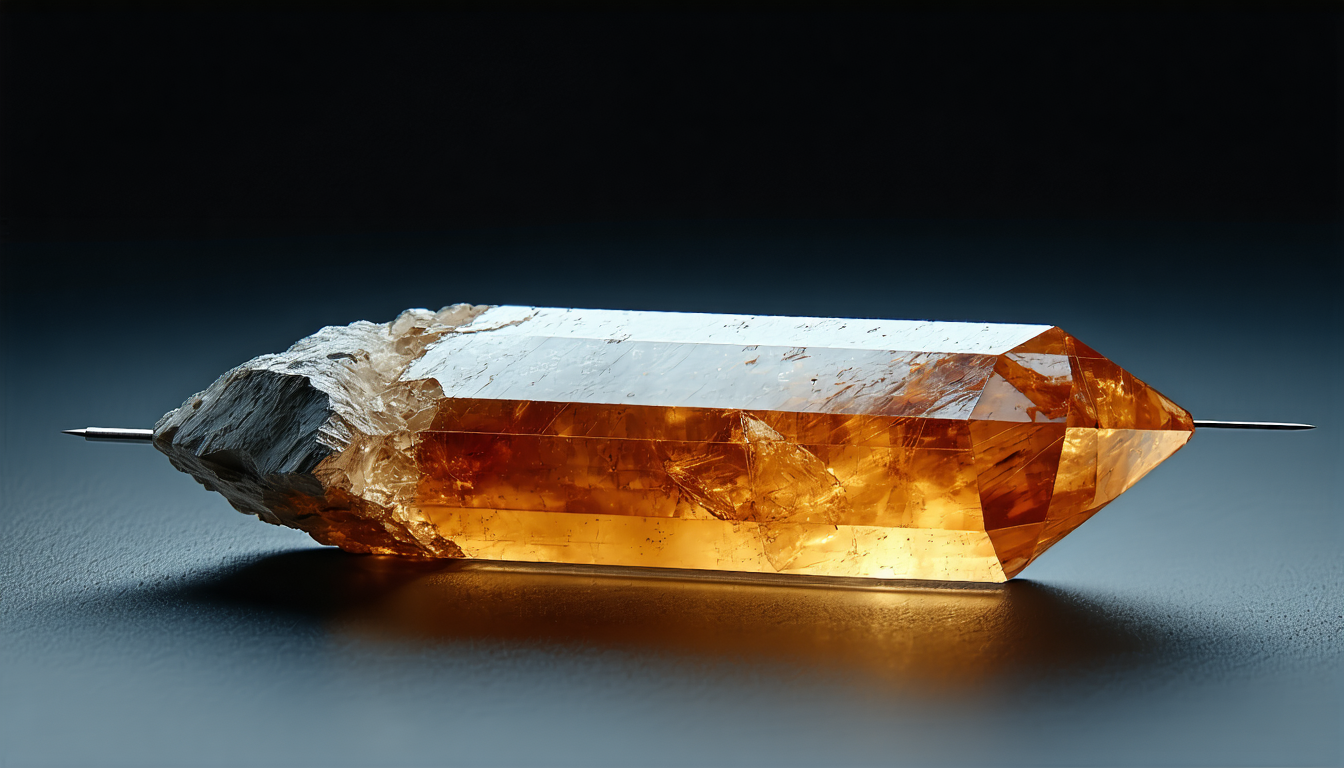
The boundaries at issue are the regions where one atomic arrangement gives way to another, and the paper calls them giant domain walls [9]. Cuprates are copper-based materials that carry electricity with no resistance at unusually high, though still very cold, temperatures [3]. In the crystal the Warwick group scanned, those boundary regions run hundreds of times wider than anyone expected to see between two crystal structures [4]. They were wide enough that the team describes them as behaving almost like a structure in their own right [5]. The scan reaches through the bulk, so the patchwork runs through the interior of the crystal [11].
Most measurements on a cuprate report one number for the whole sample. If the crystal holds two arrangements plus unusually wide transition regions, that average corresponds to a composite, and any given region inside can differ from it. Mark Senn, the Warwick chemistry professor who led the study, said the finding "means some existing bulk measurements will need to be reinterpreted and future theoretical models built that incorporate this structural complexity" [14].
On the older picture, Senn said: "For 40 years, the working assumption has been that these materials are the same all the way through, and nearly all the theory is built on that picture. We've shown it doesn't hold" [7].
He also said the wide boundary regions "likely work against superconductivity rather than just sitting alongside it" [7]. A three-dimensional map of atomic arrangements shows where the structure changes. It does not track electron pairing. The account gives the boundary widths only relative to expectation [13].
The crystals imaged belong to the 214 cuprates, one structural family within the wider copper-oxide group [9]. The measurement depended on a recent 150 million-euro upgrade at the ESRF [8], so a second group testing a second crystal depends on access to that class of beamline.
By the account's own numbers, the assumption the paper contradicts goes back to about 1986 [12]. The study, first-authored by Evie Ladbrook, is titled "Giant Domain Walls and Intrinsic Heterogeneity in 214 Cuprate Superconductors" and appears in Physical Review Letters [9].
What to watch
- Whether the same wide walls turn up when other cuprate families, and other 214 crystals, are scanned the same way.
- Whether anyone pairs the 3D structural map with a local probe of superconductivity to test Senn's expectation that the walls work against it.
- Whether groups reanalyse existing bulk cuprate data under a two-domain model.
Clarity's read
What the record supports and how the coverage leans. The claims behind it follow.
Reality
- Evidence55
- Adoption
- Not scored
- Hype gap+35
- Incentives
- Not scored
- Confidence60
Claim ledger
Ranked by verification strength, evidence, and original report placement.
- [1]
The study was led by researchers in the Department of Chemistry at the University of Warwick, working with the European Synchrotron Radiation Facility (ESRF) in France, and was published in Physical Review Letters.
- [2]
The team used a technique called scanning 3D X-ray diffraction, which the report describes as working a bit like a medical CT scan but for the arrangement of atoms inside a crystal, to build a three-dimensional picture of the material's interior for the first time.
- [3]
The material studied is a cuprate, a copper-based material that can carry electricity with no resistance at unusually high, though still very cold, temperatures.
- [4]
The scan showed a crystal divided into regions with two subtly different atomic arrangements, separated by boundaries hundreds of times wider than anyone expected to see between two crystal structures.
- [5]
The boundaries were so wide that they behaved almost like a structure in their own right, rather than a simple dividing line.
- [6]
For 40 years, most theories about how cuprates work have assumed their crystal structure is the same all the way through.
- [7]
Professor Mark Senn of the University of Warwick's Department of Chemistry, who led the study, said: "For 40 years, the working assumption has been that these materials are the same all the way through, and nearly all the theory is built on that picture. We've shown it doesn't hold. The crystal is fundamentally patchworked and textured, with unusually wide boundary regions that likely work against superconductivity rather than just sitting alongside it."
- [8]
The method was enabled by a recent 150 million-euro upgrade to the ESRF, and the team sees it as opening up the ability to look inside a wide range of materials in 3D at a level of detail not previously possible.
- [9]
The paper is Evie Ladbrook et al, "Giant Domain Walls and Intrinsic Heterogeneity in 214 Cuprate Superconductors", Physical Review Letters (2026), DOI 10.1103/r62x-kt5j.
- [10]
High-temperature superconductivity underpins research into future power grids, medical scanners and quantum computers, and promises magnets far more powerful than anything possible today.
- [11]
The imaging showed the material to be a patchwork of different crystal structures throughout its bulk, with the technique seeing deep inside the crystal for the first time.
- [12]
The uniform-structure assumption the paper contradicts dates to about 1986.
- [13]
The phys.org account gives the boundary widths only as a comparison with expectation ("hundreds of times wider than anyone expected") and does not include an absolute width figure.
- [14]
Senn said: "This might explain why some materials perform better than others and means some existing bulk measurements will need to be reinterpreted and future theoretical models built that incorporate this structural complexity."
- [15]
The team believes this kind of hidden structure is likely common across the wider family of cuprate superconductors, and possibly in other related materials being explored for superconductivity under extreme pressure.
Sources
2 independent publishers whose own reporting we read for this story.
- phys.orgChemists overturn 40-year assumption about a key class of superconductors
1 article · September 17, 2026
- sciencealert.comA 40-Year Assumption About High-Temperature Superconductors Just Fell Apart
1 article · October 6, 2026
Topics and entities
Topics
- Cuprate superconductors
- X-ray diffraction
- High-temperature superconductivity
Entities
- Physical Review Letters
- Scanning 3D X-ray diffraction
- ESRF
- University of Warwick