X-ray diffraction finds superionic ice stacking its oxygen atoms hexagonally above 200 gigapascals
A CEA-led team heated water ice past 1,800 kelvin between two diamonds and watched its oxygen atoms restack into a hexagonal lattice that takes over from the cubic phase above 200 gigapascals.
The Scientist · Science desk
What happened
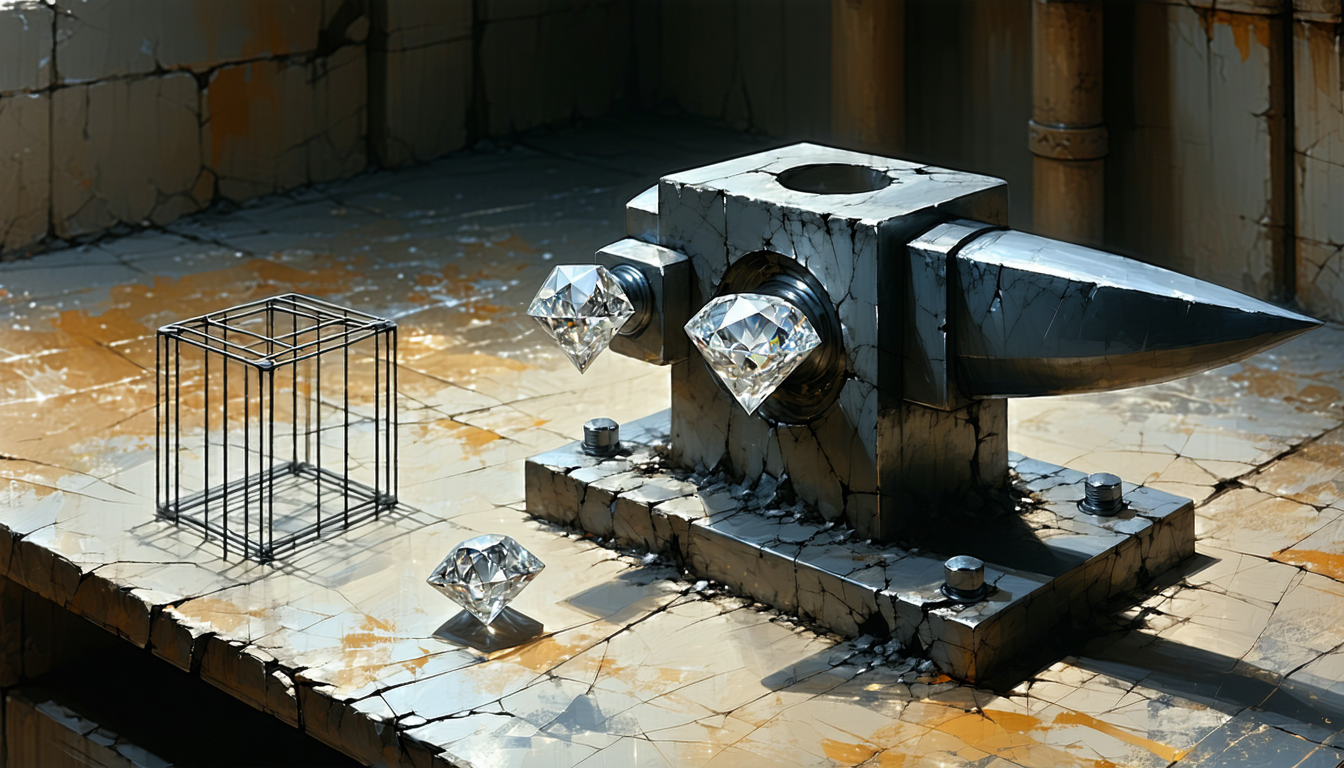
- A team led by Alexis Forestier of France's CEA squeezed tiny ice samples between two diamonds in an anvil cell and heated them with lasers to over 1,800 Kelvin.
- X-ray diffraction at the European Synchrotron Radiation Facility showed the oxygen atoms had locked into a hexagonal close-packed arrangement at pressures reaching 230 gigapascals.
- Above 200 gigapascals and 1,800 Kelvin, that hexagonal packing became the dominant phase of superionic ice, replacing the face-centered cubic phase.
- Superionic ice was already known to exist in the interiors of the ice giants, but the specific crystal shapes it forms had not been identified.
Why it matters
- What's now possible capability Modellers of ice giant interiors now have an identified oxygen symmetry to put into a water equation of state at these conditions, where the superionic phase used to enter with its structure still an open question.
- What it limits constraint The magnetic-field proposal needs the hexagonal and cubic packings to conduct differently, and phys.org reports that difference only as a possibility, so the dynamo case now has a structure and still waits on a conductivity number.
- Who has to decide decision Anyone maintaining planetary interior models has to choose: write in a phase boundary while its transport properties are still unmeasured, or wait for the conductivity runs.
Next story · Science · Sep 23
MeerKAT pins repeating radio bursts to the giant planet Beta Pictoris bConfirmed5 publishers
The pattern that comes out of a laser-heated diamond anvil cell reports where the oxygen atoms sit. Hydrogen is the part of superionic ice that moves: the nuclei flow through the solid oxygen grid like a liquid, and that flow is what makes the ice conduct electricity [7]. The diffraction fixes the geometry of the frame [1]. What the hydrogen does inside it comes from what was already understood about the superionic phase [7].
Nobody can retrieve a sample from inside Neptune, so the design is to reproduce the conditions on a bench [10]. The transition the team reports sits at 200 gigapascals and 1,800 kelvin [6], and the cell went to 230 gigapascals, which phys.org puts at more than 2 million times Earth's atmospheric pressure [5]. The hexagonal field is therefore documented across a band of roughly 30 gigapascals, about 15 percent above the boundary [12]. phys.org does not report how many heating runs produced that one corner of the phase diagram.
"We report the unambiguous observation of a novel H2O ice phase adopting an hcp oxygen sublattice," the authors wrote in the paper, which appeared in Physical Review Letters [2][11].
The link to the planets is older than the measurement. Superionic ice has been proposed as playing a role in generating the unusual magnetic fields of Uranus and Neptune [9]. For a structural result to feed that proposal, the two packings have to behave differently as conductors, and phys.org reports only that the hexagonal form may have different electrical and mechanical properties from the cubic one [14]. The paper's own statement of the planetary consequence, as phys.org quotes it, hedges the same way: "The presence of an fcc-hcp martensitic transition in the superionic regime of warm dense ice may have implications for planetary models of Uranus and Neptune" [13].
The paper's title goes further than the abstract's hedge, calling these pressures and temperatures conditions in ice giant planetary interiors [11].
Scientists knew this hot, conducting ice existed; the crystal shapes it forms were the open question [8]. A symmetry measured at a stated pressure and temperature can go into an equation of state. In my view the dynamo story stays where it was until someone measures conductivity in the hexagonal phase at 200 gigapascals and above.
What to watch
- Electrical conductivity measured in the hcp phase at 200 gigapascals and above. The magnetic-field proposal rests on it.
- Runs past 230 gigapascals that map the slope of the fcc-hcp boundary beyond this one corner.
- Whether interior models rerun with hcp elastic and transport properties predict different field geometries for the two planets.
Clarity's read
What the record supports and how the coverage leans. The claims behind it follow.
Reality
- Evidence72
- Adoption20
- Hype gap+18
- Incentives30
- Confidence66
Claim ledger
Ranked by verification strength, evidence, and original report placement.
- [1]
X-ray diffraction at the European Synchrotron Radiation Facility revealed that the oxygen atoms had locked into a hexagonal pattern known as hexagonal close-packed (hcp).
- [2]
"We report the unambiguous observation of a novel H2O ice phase adopting an hcp oxygen sublattice," the study authors said.
- [3]
The experiment was carried out by a team of scientists led by Alexis Forestier of the CEA, France's Alternative Energies and Atomic Energy Commission.
- [4]
The team squeezed tiny samples of ice between two ultra-hard diamonds inside a diamond anvil cell and heated the trapped ice with lasers to over 1,800 Kelvin.
- [5]
The samples were subjected to pressures reaching 230 gigapascals, which phys.org describes as more than 2 million times Earth's atmospheric pressure.
- [6]
Above 200 gigapascals and 1,800 Kelvin, the hcp form became the dominant phase of superionic ice, replacing the face-centered cubic (fcc) phase.
- [7]
In the superionic phase, oxygen atoms lock into a solid grid while hydrogen nuclei flow freely through it like a liquid, allowing the ice to conduct electricity.
- [8]
Scientists already knew this hot, conducting ice existed, but they did not know what specific crystal shapes it formed.
- [9]
In planets like Uranus and Neptune, superionic ice has been proposed as playing a role in generating their unusual magnetic fields.
- [10]
Scientists cannot dig out ice from inside planets like Neptune and Uranus and transport it back to Earth, so they recreate those extreme conditions in the lab.
- [11]
The work was published in Physical Review Letters (2026) as Alexis Forestier et al, "Observation of Hexagonal Close-Packed Water Ice at Conditions in Ice Giant Planetary Interiors", DOI 10.1103/sdrk-3m4t, with a preprint at arXiv:2510.24305.
- [12]
The hcp phase is reported as dominant from 200 gigapascals up to the 230 gigapascals the cell reached, a band of 30 gigapascals, or about 15 percent above the transition pressure.
- [13]
"The presence of an fcc-hcp martensitic transition in the superionic regime of warm dense ice may have implications for planetary models of Uranus and Neptune."
- [14]
Because the hexagonal form may have different electrical and mechanical properties from the cubic one, phys.org reports, the discovery could change how scientists model those planetary interiors.
Sources
2 independent publishers whose own reporting we read for this story.
- newscientist.comTwo bizarre new forms of ice discovered that could exist deep inside planets
1 article · September 14, 2026
- phys.orgScientists discover a strange new form of ice that could help explain the interiors of Neptune and Uranus
1 article · September 11, 2026
Topics and entities
Topics
- Planetary magnetic fields
- High-pressure physics
- X-ray diffraction
- Ice giant interiors and diamond rain
Entities
- Physical Review Letters
- arXiv
- Alexis Forestier
- University of Edinburgh
- European Synchrotron Radiation Facility