Earth snow physics shrinks the dust estimate for Mars's north polar ice from 25 to 3 percent
University of Washington researchers put the dust in Mars's north polar surface ice near 3% by mass, down from earlier estimates as high as 25%. Cleaner ice is brighter and should vaporize more slowly, so the figure bears on Mars climate models.
The Scientist · Science desk
What happened
- The earlier dust figures came from a method built to study lunar soil, and its results seemed off when Khuller checked it against ice on Earth.
- Recent UW geoscience graduate Pari Mohan and Khuller redid the calculation with an approach from Steve Warren, a UW professor emeritus who studies snow and ice.
- The team combined data from the Phoenix lander, which sampled ice near the north pole in 2008, with observations from orbiting satellites.
- The polar ice is layered like a sandwich, with a dusty frost that forms each winter and disappears in summer to expose older, cleaner ice.
Why it matters
- What it limits constraint Climate estimates built on surface ice that is up to a quarter dust would make the north polar ice darker and warmer than this study finds, and so overstate how fast it vaporizes.
- What it limits constraint Reading the polar ice from orbit means separating a dusty winter frost from the cleaner ice beneath it, or the older climate-bearing layers will look dustier than they are.
- What it sets up precedent The study argues for testing planetary ice methods against Earth ice before using them on Mars, since the lunar-soil approach's problems showed up in exactly that check.
Next story · Science · 5h ago
Baker lab's from-scratch zinc proteases cut their chosen target in 36% of 135 designsConfirmed2 publishers
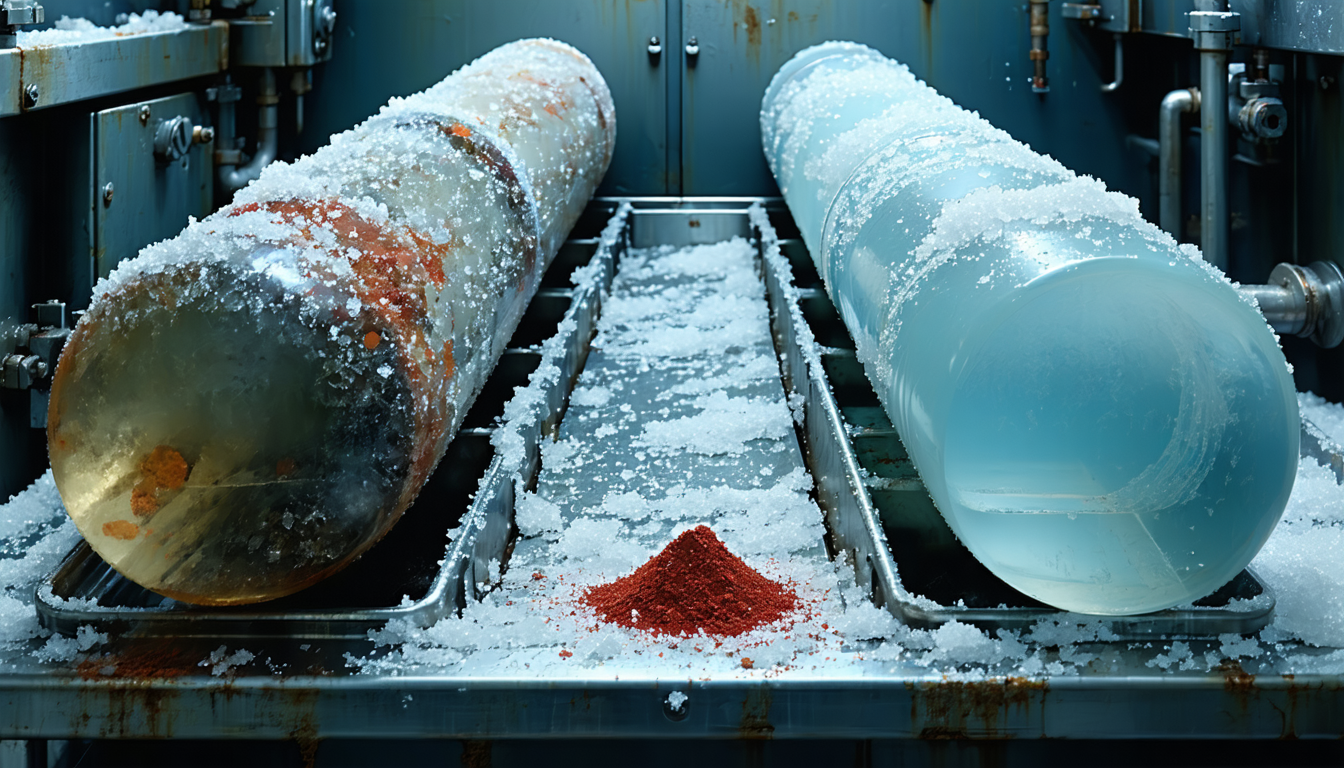
The Earth test is the part of this design I would single out. Polar ice on Earth can be drilled and pulled out as long cores [15], so a method's answer there can be compared with the ice itself. The replacement method had already passed that kind of test. "His methods had been used successfully to study snow and ice on Earth for decades. So I thought it would be interesting to adapt these Earth-tested methods to Mars," said Aditya Khuller, a senior research scientist at the UW's Applied Physics Laboratory [8].
The question going in was open. "We know there is water ice in the area surrounding the north pole of Mars, but there has been widespread disagreement as to how dusty that ice is," Khuller said [3]. The answer in the study, published in npj Space Exploration [1], is a big revision. Earlier estimates put the top layer of polar ice at as much as 25% dust by mass. The new figure is closer to 3% [2], about an eighth of the old high end [18]. Because 25% was the top of the earlier range, the gap against more moderate older estimates would be smaller. The 3% also describes the top layer, and says less about the full depth of the ice.
Dust matters because it darkens ice and changes how much sunlight goes back into space [5]. "If it is dustier, the ice will be darker. Just like a dark T-shirt in the sun makes you warmer, dusty ice gets warmer and vaporizes faster on Mars," Khuller said [4]. Apply the same physics to cleaner ice and it comes out brighter, and it should vaporize more slowly than the older estimates imply. The thing this doesn't tell you is how much more slowly: the phys.org account does not include a revised vaporization rate, a reflectivity figure or an uncertainty range for the 3%.
The seasonal frost affects how the ice should be read. "By looking at how the brightness changed over time, we figured out that there is a frost that forms in the winter and it's more dusty. In the Martian summer it goes away, exposing cleaner, older ice," Khuller said [11]. An orbital view taken in winter would mostly be looking at that fresh, dustier frost [10]. The older layers hold details of Martian climate from thousands of years ago, when the ice is thought to have formed from snowfall [12].
Those layers come from large ice ages that left shallow ice on roughly a third of the planet [16]. Earth is stabilized by its moon's pull. Mars, with two small moons, "oscillates wildly," Khuller said [17].
The dusty layers inside the sandwich also bear on a separate idea. In earlier work, Khuller and colleagues suggested that dark layers could trap sunlight and form pockets of meltwater, enriched with nutrients from the dust, that could potentially host bacteria [13]. The new study estimated dust content. The meltwater idea is still a proposal from that earlier paper. "Why does one planet have life and the other doesn't?" Khuller said [14].
What to watch
- Published vaporization rates or reflectivity values for the north polar ice recalculated with the 3% dust figure, and the uncertainty range on that figure.
- Whether the Warren-based method gives similar dust estimates when applied to other Martian ice, including the south polar deposits.
- Independent orbital measurements that confirm or contradict the seasonal dusty-frost layer over cleaner ice.
Clarity's read
What the record supports and how the coverage leans. The claims behind it follow.
Reality
- Evidence58
- Adoption
- Not scored
- Hype gap+12
- Incentives25
- Confidence60
Claim ledger
Ranked by verification strength, evidence, and original report placement.
- [1]
A University of Washington study published in npj Space Exploration shows that the north pole of Mars contains less dust than scientists thought.
- [2]
Previous estimates suggested that the top layer of polar ice contained as much as 25% dust by mass; this study says it is closer to 3%.
- [3]
"We know there is water ice in the area surrounding the north pole of Mars, but there has been widespread disagreement as to how dusty that ice is," said Aditya Khuller, a senior research scientist at the UW's Applied Physics Laboratory.
- [4]
"If it is dustier, the ice will be darker. Just like a dark T-shirt in the sun makes you warmer, dusty ice gets warmer and vaporizes faster on Mars," Khuller said.
- [5]
Dust affects climate by darkening ice, which changes how much sunlight is reflected into space.
- [6]
The leading approach for analyzing the physical properties of Martian ice was developed for studying soil on the moon; when Khuller checked its accuracy on Earth, the results seemed off.
- [7]
Pari Mohan, who recently graduated from UW with a degree in geoscience, worked with Khuller to redo the calculations using a method based on an approach developed by Steve Warren, UW professor emeritus of Earth and space science and an expert in analyzing snow and ice.
- [8]
"His methods had been used successfully to study snow and ice on Earth for decades. So I thought it would be interesting to adapt these Earth-tested methods to Mars," Khuller said.
- [9]
The UW researchers used data from the Mars Phoenix mission, which in 2008 sampled ice near the north pole, combined with observations from orbiting satellites.
- [10]
The north pole is stacked 'like an ice cream sandwich,' with layers of dustier ice between slabs of cleaner ice; a dusty layer of frost forms over the ice every winter and disappears in the summer, revealing older, cleaner ice.
- [11]
"By looking at how the brightness changed over time, we figured out that there is a frost that forms in the winter and it's more dusty. In the Martian summer it goes away, exposing cleaner, older ice," Khuller said.
- [12]
The layers contain key details about the climate of Mars thousands of years ago, when the ice is thought to have formed from snowfall.
- [13]
In a previous study, Khuller and colleagues suggested that dark dust-ice layers could trap sunlight and form pockets of meltwater, enriched with nutrients from the dust, that could potentially host bacteria and primitive life forms.
- [14]
"Why does one planet have life and the other doesn't?" Khuller said.
- [15]
On Earth, scientists drill deep into polar ice to draw out long cylinders that contain a record of the local atmosphere and can be dated to ancient periods.
- [16]
Mars experiences massive ice ages that have deposited shallow ice on roughly one-third of the planet.
- [17]
Earth is stabilized by the gravitational pull of its moon; Mars, having only two small moons, "oscillates wildly," Khuller said, which causes its dramatic ice ages.
- [18]
The new 3% dust estimate is about one-eighth (12%) of the highest earlier estimate of 25%.
Sources
2 independent publishers whose own reporting we read for this story.
- gizmodo.comScientists Thought Mars’s North Polar Ice Was 25% Dust. They Were Way Off
1 article · October 2, 2026
- phys.orgThe north pole of Mars is less dusty than scientists thought
1 article · September 30, 2026
Topics and entities
Topics
- Planetary Science
- Radiative transfer modelling
Entities
- University of Washington Applied Physics Laboratory
- npj Space Exploration
- NASA
- University of Washington