AEP plans to spend $4 billion on 702 MW of Bloom fuel cells for Google near Cheyenne
AEP plans to invest about $4 billion in a 702 MW Bloom fuel cell plant near Cheyenne, Wyoming, under a 20-year power purchase agreement with Google. The sum equals about 5% of the $78 billion AEP plans to invest from 2026 through 2030.
The Investor · Invest desk
Key figures: the $4 billion investment over 702 MW is about $5.70 million per megawatt, disputed; the January Bloom purchase, at least $2.94 million per megawatt if $2.65 billion bought the full 900 MW; Constellation's commitment, more than $4.83 million per megawatt, disputed.
| Figure | Value | Note | Claim |
|---|---|---|---|
| $4B investment over 702 MW | $5.7M per MW, about | disputed | 17 |
| January Bloom purchase | $2.94M per MW, at least | if $2.65B bought the full 900 MW | 18 |
| Constellation's commitment | $4.83M per MW, over | disputed | 20 |
What happened
- Google will buy the power from Cheyenne Fuel Cell, LLC, which AEP owns and controls at about 92%, with funds advised by Basalt Infrastructure Partners holding nearly 8%.
- AEP and its partners plan to start construction in 2026, and the facility is expected to be fully operational by the end of 2028.
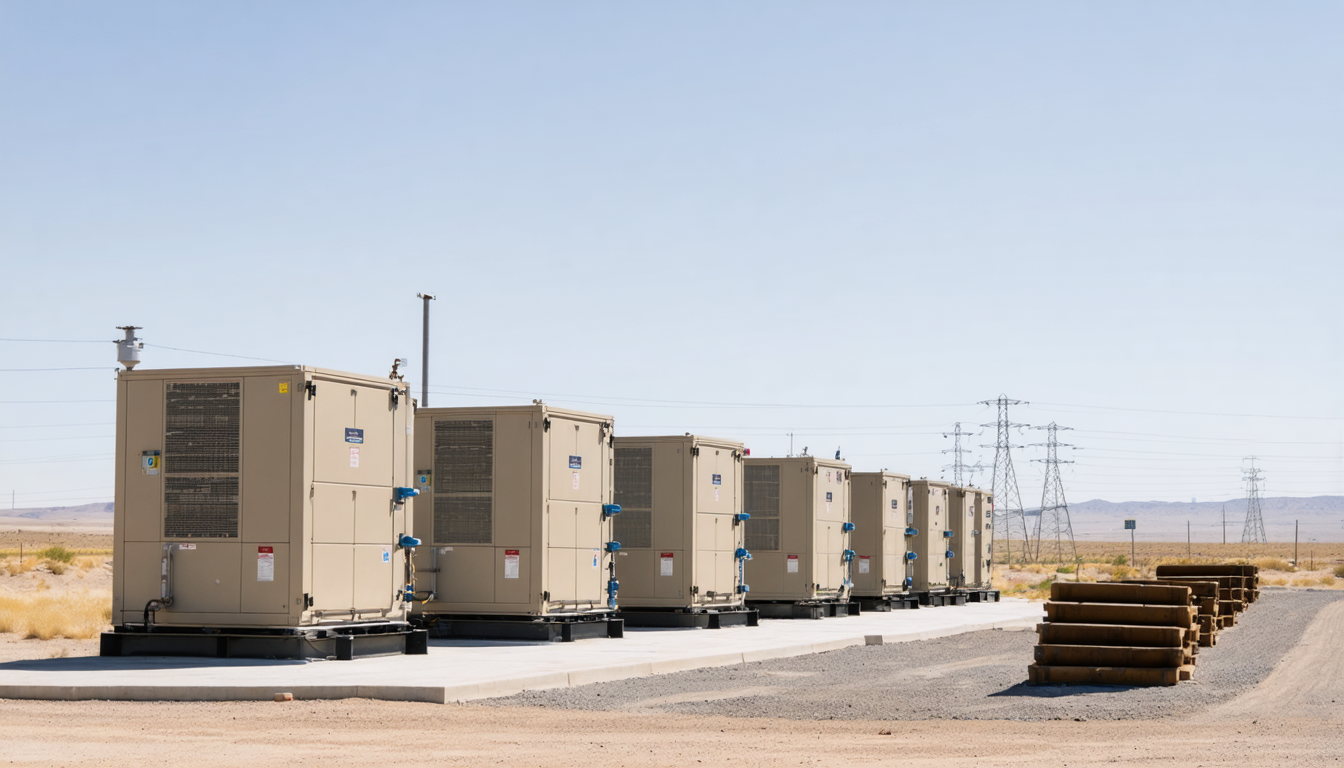
- The Bloom Energy cells generate electricity without combustion of natural gas, and the project includes plans to integrate carbon capture for near-zero-emissions power.
- Quartz, citing AEP, said the deal follows a separate Google agreement with Black Hills Corp., effective Sept. 30, to power Google's proposed data center in the Cheyenne area.
Why it matters
- Who's exposed exposure AEP's cash at risk is between about $3.68 billion and $4 billion, depending on whether the $4 billion is the whole project or only its 92% share. It rests on one buyer for 20 years.
- What doesn't add up contradiction A grid-bypass reading needs the plant to replace utility service. But Google also has a Black Hills agreement for its proposed Cheyenne-area data center, so the sources fit added supply at least as well.
- What it costs cost The suppliers fund the build: AEP's $4 billion and Constellation's more than $4.3 billion are theirs to raise, and Google pays for them through the price of power over 20 years.
- What it sets up precedent A project company with outside equity from Basalt, selling to one hyperscaler, is a template Fehrman's remarks suggest AEP may repeat for customers beyond its traditional territory.
Next story · Invest · 3d ago
A $138 million Pennsylvania contract makes up under 28% of LS ELECTRIC's Bloom ordersConfirmed4 publishers
Divide $4 billion by 702 megawatts and the plant costs about $5.70 million per megawatt [17]. That is the floor. A $4 billion that covers only AEP's 92% would put the whole project near $6.19 million [23]. The January Bloom purchase was valued at about $2.65 billion for a portion of up to 900 megawatts, according to Reuters as cited by Quartz [12]. That comes to no less than $2.94 million per megawatt [18], and a smaller portion would only raise it. On the lower reading of the Wyoming cost, the gap between the two is at most about $2.75 million per megawatt [19]. Integrated carbon capture, which AEP says is planned [5], may account for part of it.
Google's other recent contracts give a second yardstick. Constellation is committing more than $4.3 billion to 890 megawatts of new nuclear capacity under a 20-year Google agreement [8]. That is more than $4.83 million per megawatt [20]. On the $4 billion-total reading, the fuel cells cost at most about 18% more per nameplate megawatt [21]. (Nameplate is a crude measure. A plant that runs more hours a year delivers more energy per megawatt.) Add Fervo's 396-megawatt geothermal agreement from September [9] and the three Google contracts with disclosed sizes total 1,988 megawatts [14].
The sources support a narrower claim than a hyperscaler buying its way off the grid. AEP's release says the plant is "supporting Google's growing energy needs in the greater Cheyenne area" [6] and sells the output through a 20-year contract with a project company [1][4]. It does not say whether the plant sits on Google's site or connects through the grid.
What the release does stress is speed. The technology "can be deployed rapidly" [11], and the clock runs about 26 months from the Oct. 14 announcement to full operation [15]. Bill Fehrman, AEP's chairman, president and chief executive, said: "This project demonstrates how we are creating new opportunities to meet evolving energy needs for customers both within and beyond our traditional service territory." [10]
We think the evidence supports speed and a long contract. A filing showing a dedicated line from the plant to Google's data center would change that view.
What to watch
- Wyoming interconnection or tariff filings that show whether the plant delivers to Google's data center over a dedicated line or through the grid.
- The size and terms of Google's Black Hills agreement, which would show whether the utility supplies primary power or backup.
- AEP's itemization of the $4 billion, and whether the 702 MW draws on the January Bloom option for up to 900 MW.
Information, not investment advice. This story is general information about companies and markets, drawn from cited reporting. It is not a recommendation to buy, sell or hold any security; check the cited sources before acting.
Clarity's read
What the record supports and how the coverage leans. The claims behind it follow.
Reality
- Evidence55
- Adoption30
- Hype gap+20
- Incentives65
- Confidence60
Perspective Coverage
3 publishers- Builder
- Builder 27%
- Operator
- Operator 40%
- Investor
- Investor 33%
Claim ledger
Ranked by verification strength, evidence, and original report placement.
- [1]
American Electric Power plans to invest approximately $4 billion to advance a new 702-megawatt fuel cell generation project near Cheyenne, Wyoming, under a long-term 20-year power purchase agreement with Google.
- [2]
AEP and its partners plan to start construction in 2026, and the facility is expected to be fully operational by the end of 2028.
- [3]
AEP's release announcing the project is dated October 14, 2026.
- [4]
Google will acquire power from Cheyenne Fuel Cell, LLC, which is approximately 92% owned and controlled by AEP and nearly 8% owned by funds advised by Basalt Infrastructure Partners, LLP.
- [5]
The planned facility uses Bloom Energy fuel cell technology that generates electricity without combustion of natural gas, and the project includes plans to integrate carbon capture technology to deliver near-zero-emissions power.
- [6]
AEP's release says its development and construction of the fuel cell facility is "supporting Google's growing energy needs in the greater Cheyenne area".
- [7]
The AEP agreement follows a separate deal Google reached with Black Hills Corp., effective September 30, to power its proposed data center in the Cheyenne area.
- [8]
Google announced a 20-year power purchase agreement with Constellation Energy covering 890 megawatts of new nuclear capacity, with Constellation committing more than $4.3 billion to fund that project.
- [9]
In September, Google signed a 396-megawatt enhanced geothermal power purchase agreement with Fervo Energy to supply electricity for a potential data center in Utah.
- [10]
"This project demonstrates how we are creating new opportunities to meet evolving energy needs for customers both within and beyond our traditional service territory."
- [11]
AEP's release says the Bloom Energy fuel cell technology "can be deployed rapidly" and provide reliable, on-demand power for large-load customers.
- [12]
In January, AEP exercised an option to purchase a portion of up to 900 megawatts of additional Bloom Energy fuel cells in a deal valued at approximately $2.65 billion.
- [13]
AEP plans to invest $78 billion from 2026 through 2030 to enhance service for customers and support the growing energy needs of its communities.
- [14]
The three Google contracts with disclosed sizes (AEP 702 MW, Constellation 890 MW, Fervo 396 MW) total 1,988 MW.
- [15]
From the October 14, 2026 announcement to the end of 2028 is about 26 months.
- [16]
The $4 billion equals about 5% of AEP's $78 billion plan for 2026 through 2030.
- [17]
The $4 billion investment over 702 MW is about $5.70 million per megawatt.
- [18]
The January Bloom purchase works out to at least $2.94 million per megawatt, if the $2.65 billion bought the full 900 MW; a smaller portion would raise the figure.
- [19]
On the $4 billion-total reading, the gap between the Wyoming cost per megawatt and the January Bloom figure is at most about $2.75 million per megawatt.
- [20]
Constellation's commitment works out to more than $4.83 million per megawatt.
- [21]
On the $4 billion-total reading, the Wyoming fuel cells cost at most about 18% more per nameplate megawatt than Constellation's nuclear commitment.
- [22]
AEP's cash at risk is between about $3.68 billion (92% of $4 billion, if $4 billion is the whole project) and $4 billion (if the $4 billion is AEP's own investment).
- [23]
If the $4 billion covers only AEP's 92% share, the whole project costs about $4.35 billion, or about $6.19 million per megawatt.
Sources
3 independent publishers whose own reporting we read for this story.
- datacenterdynamics.comGoogle signs 20-year PPA with AEP for 702MW Wyoming fuel cell project
1 article · October 14, 2026
- prnewswire.comAEP Advances Innovative Energy Solution for Google with 702MW of Bloom Fuel Cells
1 article · October 14, 2026
- qz.comAEP plans to invest $4 billion in Wyoming fuel cell plant to power Google
1 article · October 14, 2026
Topics and entities
Entities
- Constellation Energy
- American Electric Power
- Bloom Energy
- Black Hills Corp.
- Basalt Infrastructure Partners
- Fervo