Kimi K3's real gate is 1.4TB of VRAM and a bespoke licence, not engineering
Moonshot published 2.8 trillion open weights. At four bits per parameter that is about 1.4TB resident before any cache, which rules out the eight-way H100 node most teams assume.
The Engineer · Build desk
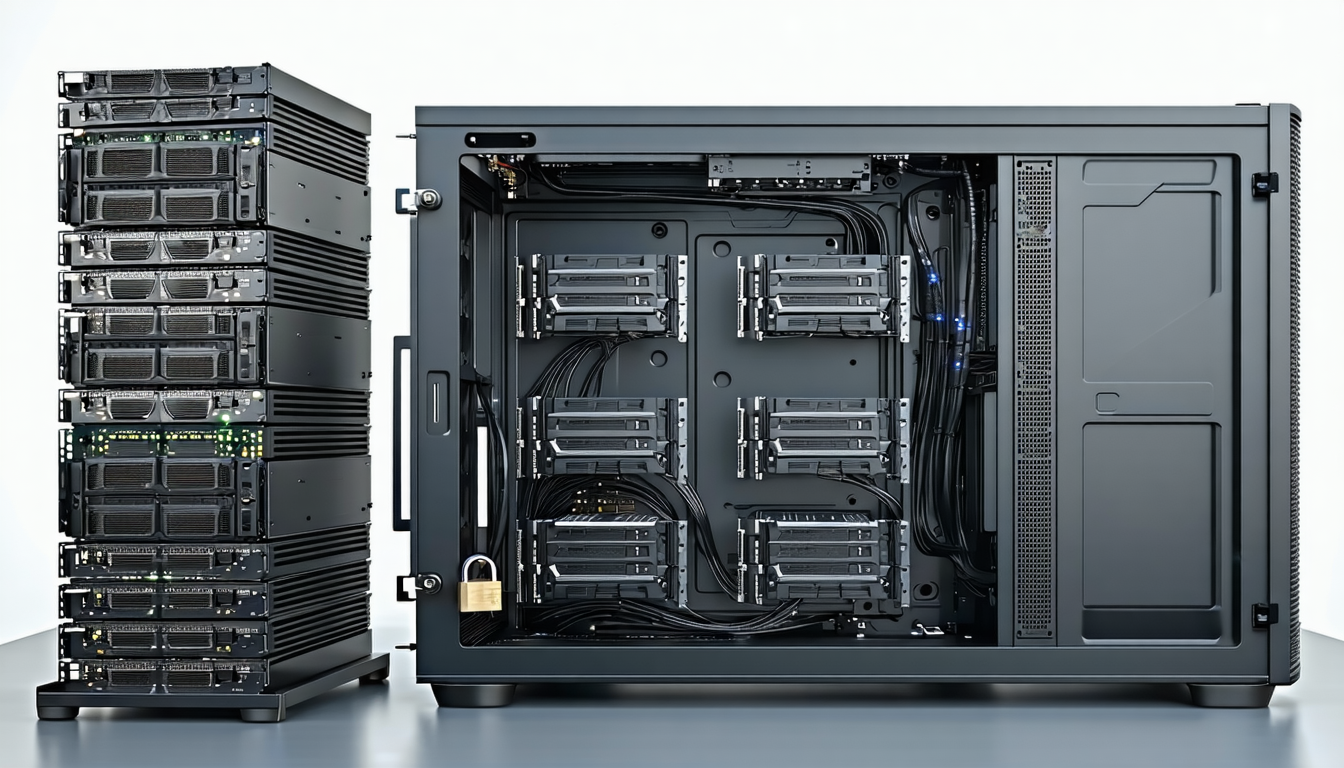
What happened
- Self-hosting Kimi K3 became technically possible on 27 July 2026, when Moonshot AI published the weights for a 2.8-trillion-parameter model alongside production inference support.
- The engineering of self-hosting the model is achievable; the arithmetic is what defeats most projects, and it defeats them quietly, several months after the budget was approved.
- At MXFP4 precision, four bits per parameter, 2.8 trillion parameters occupy approximately 1.4 TB, and all of it must be resident in accelerator memory to serve requests at reasonable speed.
- A model advertising a million-token context must keep attention state for every concurrent request, and that key-value cache allocation scales with both context length and batch size.
- Published vLLM metadata puts the minimum viable serving footprint at roughly 1,680 GB, consistent with weights plus a modest cache and no headroom for ambitious batching.
Why it matters
Moonshot AI published the weights for Kimi K3, a 2.8-trillion-parameter model, on 27 July 2026, alongside production inference support [1]. The engineering of serving it is achievable; according to the dev.to teardown of the deployment, it is the arithmetic that defeats projects, and it does so quietly, several months after the budget is approved [23].
Start with the weights, because every other requirement follows from them. At MXFP4, roughly four bits per parameter, 2.8 trillion parameters occupy about 1.4 TB, and all of it has to be resident in accelerator memory to serve requests at reasonable speed [5]. Then the key-value cache: the model advertises a million-token context, and attention state for every concurrent request scales with both context length and batch size [2]. Published vLLM metadata puts the minimum viable serving footprint at roughly 1,680 GB [6], which leaves on the order of 280 GB above the weights for cache and overhead [19].
That figure eliminates the configuration most teams have already sketched. Eight H100s at 80 GB provide 640 GB, less than half what the weights alone require [7]. Put differently, a full eight-way H100 node covers about 38 percent of the minimum serving footprint [20], and reaching 1,680 GB with 80 GB cards takes three such nodes on paper [21], which converts a memory shortfall into an interconnect problem.
Interconnect is where the architecture bites. Kimi K3 is a mixture of experts that routes each token to sixteen of 896 experts, about 1.8 percent of them [3][18], which generates substantial all-to-all traffic between the devices holding different experts [3]. A box with adequate total memory and weak interconnect will deliver throughput far below the specification sheet, and diagnosing that after purchase is an expensive lesson [4].
The shapes that actually work: eight current-generation 288 GB accelerators, NVIDIA B300 or AMD MI355X, give around 2.3 TB in a single node [8], roughly 620 GB above the minimum footprint for batching [22]; sixteen B200 or GB200-class cards reach a similar total across a larger footprint [9]; and for sustained production rather than a proof of concept, Moonshot's own guidance points at supernodes of sixty-four or more accelerators [10].
Before any of that, the licence. The weights carry a custom grant the model card names the Kimi K3 License, not a plain MIT or Apache grant, and third-party summaries describing it as one should not be relied upon [11]. The specific things to read for are attribution requirements and conditions that attach at particular scales of use [12]. That review is an afternoon of work and it determines whether the hardware conversation is worth having.
What the weights buy is control: data never leaves the estate, nobody deprecates the model or changes the price, and you can fine-tune, quantise further or modify serving behaviour in ways an API will not permit [13]. What they do not buy is a cheaper way to do what the API already does [14].
The software side is more settled. The model card lists vLLM, SGLang and TokenSpeed as supported engines [15], and support for Kimi Delta Attention shipped alongside the weights rather than arriving later, so a current vLLM build has the kernels while an older installation does not, which is the first thing to check when a deployment refuses to start [16]. Then plan the logistics of pulling and storing over a terabyte of weights [17].
Three things to watch on any K3 plan: which licence conditions trigger at your usage scale [12], whether the interconnect story matches sixteen-of-896 routing rather than just total VRAM [3], and the exact engine version in the image [16].
Clarity's read
What the record supports and how the coverage leans. The claims behind it follow.
Reality
- Evidence60
- Adoption
- Not scored
- Hype gap+10
- Incentives40
- Confidence58
Claim ledger
Ranked by verification strength, evidence, and original report placement.
- [1]
Self-hosting Kimi K3 became technically possible on 27 July 2026, when Moonshot AI published the weights for a 2.8-trillion-parameter model alongside production inference support.
- [2]
A model advertising a million-token context must keep attention state for every concurrent request, and that key-value cache allocation scales with both context length and batch size.
- [3]
Kimi K3 is a mixture-of-experts architecture routing each token to sixteen of 896 experts, which generates substantial all-to-all communication between the devices holding different experts.
- [4]
A configuration with adequate total memory but weak interconnect will produce throughput far below what the specification sheet suggests, and diagnosing that after purchase is an expensive lesson.
- [5]
At MXFP4 precision, four bits per parameter, 2.8 trillion parameters occupy approximately 1.4 TB, and all of it must be resident in accelerator memory to serve requests at reasonable speed.
- [6]
Published vLLM metadata puts the minimum viable serving footprint at roughly 1,680 GB, consistent with weights plus a modest cache and no headroom for ambitious batching.
- [7]
Eight H100 cards at 80 GB provide 640 GB, which is less than half of what the weights require, so a single eight-way H100 node cannot serve the model at all.
- [8]
Eight current-generation accelerators with 288 GB each, whether NVIDIA B300 or AMD MI355X, give around 2.3 TB in a single node and are the most straightforward option.
- [9]
Sixteen B200 or GB200-class cards reach a similar total memory across a larger footprint.
- [10]
For sustained production throughput rather than a proof of concept, Moonshot's own guidance points at supernode configurations of sixty-four or more accelerators.
- [11]
The published weights carry a custom licence that the model card names the Kimi K3 License; it is not a plain MIT or Apache grant, and third-party summaries describing it as one should not be relied upon.
- [12]
Readers are advised to review the licence text before committing to commercial deployment, paying attention to attribution requirements and to any conditions that attach at particular scales of use.
- [13]
What the weights buy is control: data never leaves your estate, nobody deprecates the model or changes the price, and you can fine-tune, quantise further or modify serving behaviour in ways an API will never permit.
- [14]
What the weights do not buy is a cheaper way to do what the API already does.
- [15]
The model card lists vLLM, SGLang and TokenSpeed as supported inference engines.
- [16]
Support for Kimi Delta Attention shipped alongside the weights rather than arriving later, so a current build of vLLM includes the kernels the architecture needs while an older installation will not; this is the first thing to check when a deployment refuses to start.
- [17]
Deployment logistics include pulling and storing over a terabyte of weight data.
- [18]
Routing each token to sixteen of 896 experts activates about 1.8 percent of the experts per token.
- [19]
The 1,680 GB minimum serving footprint leaves roughly 280 GB above the 1.4 TB of weights for key-value cache and overhead.
- [20]
An eight-way H100 node's 640 GB is about 38 percent of the 1,680 GB minimum serving footprint.
- [21]
Reaching the 1,680 GB minimum with 80 GB H100 cards requires three eight-way nodes, 1,920 GB in total.
- [22]
A single node of eight 288 GB accelerators at about 2.3 TB leaves roughly 620 GB above the 1,680 GB minimum serving footprint.
- [23]
The engineering of self-hosting the model is achievable; the arithmetic is what defeats most projects, and it defeats them quietly, several months after the budget was approved.
Sources
2 independent publishers whose own reporting we read for this story.
- dev.toSelf-Hosting Kimi K3: Hardware, Cost and Sovereignty
1 article · August 20, 2026
- runtimewire.comMoonshot released Kimi K3's weights on July 27, extending its open-weight push
1 article · August 21, 2026
Topics and entities
Topics
- AI model licensing
- Open-Weight Model Publishing
- LLM Inference Hardware
- Mixture of Experts Architectures
Entities
- Moonshot AI
- Nvidia H100
- Yang Zhilin
- SGLang
- Kimi-K3
- Kimi Delta Attention
- vLLM
- Nvidia B300