Trucked gas for Oracle's Project Jupiter would empty a trailer every 40 minutes per 100 MW
Oracle is trucking compressed gas to AI data centers with late pipelines and weighing the same fix for its 2.45 GW Project Jupiter, Bloomberg reported. One analyst puts trucked gas at about four times the cost of pipeline supply, though at Jupiter's scale the number of trailers an hour is the tighter limit.
The Investor · Invest desk
Bar chart of compressed-gas trailers needed per day on trucked gas: 36 at 100 MW versus 882 at Project Jupiter's full 2.45 GW, roughly one trailer every 98 seconds.
Trailers a day at one trailer per 40 minutes per 100 MW, scaled linearly In trailers a day
| Item | Value | Claim |
|---|---|---|
| 100 MW | 36 trailers a day | 18 |
| Full 2.45 GW | 882 trailers a day | 19 |
What happened
- Energy Transfer had to reroute the Jupiter pipeline after state regulators rejected its original path, pushing the target in-service date from this summer to next year.
- Oracle sent a force majeure notice to Jupiter's developer last month, a move Bloomberg said may shield it from certain payments if delays continue.
- Trucked gas kept an Oracle data center near Salt Lake City running for more than a year while it waited for a pipeline connection.
- After Bloomberg asked for comment, Oracle posted on social media crediting VoltaGrid, its gas supplier at an OpenAI campus in Texas, with keeping its cloud infrastructure on schedule.
Why it matters
- What it limits constraint Trucks can power only Jupiter's early stages, so the campus as a whole cannot come online before Energy Transfer's rerouted pipeline does.
- Who's exposed exposure If the pipeline slips past next year, Jupiter's developer may end up absorbing the delay through payments Oracle's notice could let it withhold.
- What it costs cost Each month of trucked fuel is paid out of negative free cash flow, so the premium becomes part of what Oracle's new lenders and shareholders end up funding.
Next story · Invest · 2d ago
Oracle presses FERC to speed a 17.8-mile gas pipeline that has slipped 170 daysConfirmed2 publishers
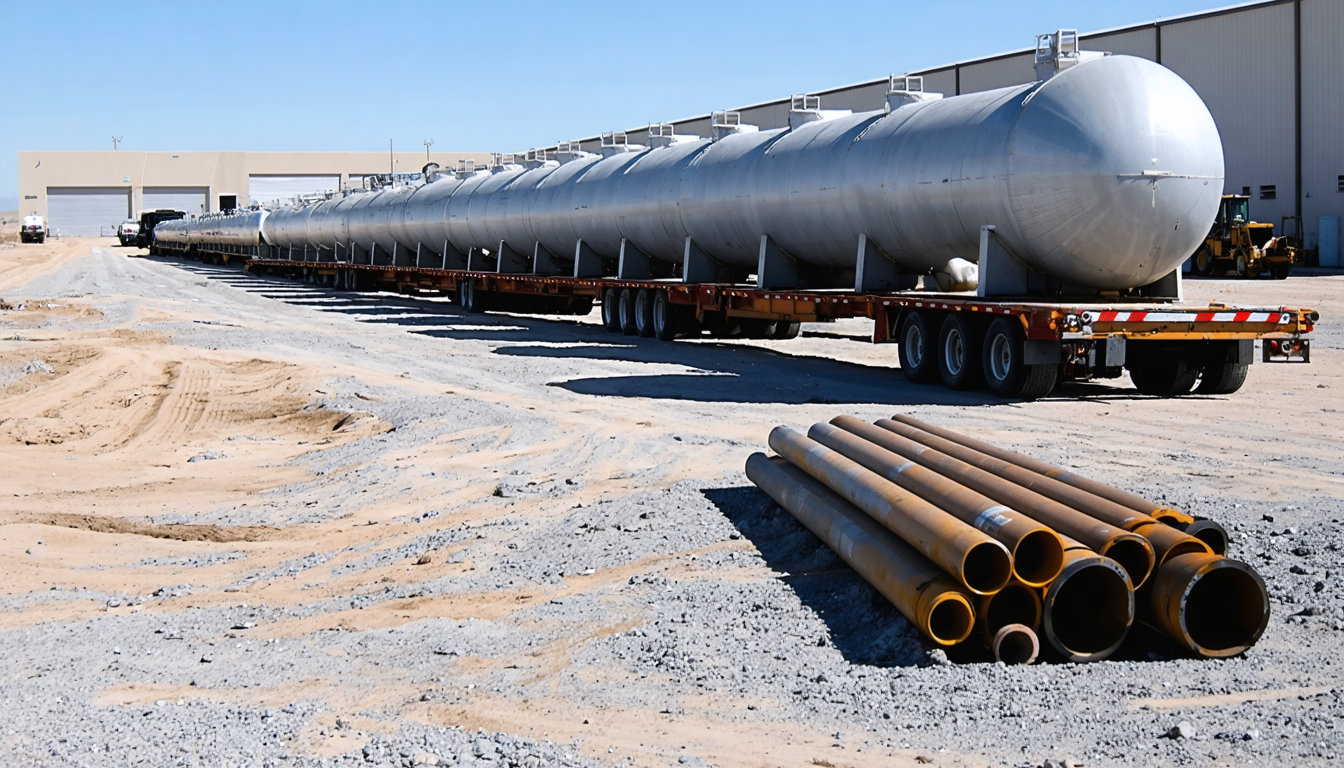
At 100 megawatts of demand, about 4% of Jupiter's planned capacity, a large compressed-gas trailer runs dry in around 40 minutes, according to SemiAnalysis energy analyst Ellie Holbrook, as cited by Bloomberg [13]. That works out to 36 trailers a day for roughly a twenty-fifth of the site [18]. Scaled in a straight line to the full 2.45 gigawatts, it comes to about 880 trailers a day, or one every 98 seconds [19]. Each load is compressed into a trailer and hauled for what can be several hours before it is decompressed to run generators [10]. At 1.5 arrivals an hour per 100 megawatts, each hour of one-way driving puts another 1.5 loaded trailers on the road [20].
Bloomberg describes the Jupiter plan as a way to bring early stages online before the pipeline enters service [4]. Trucked gas costs about four times what pipeline delivery from a major hub would, once labor, equipment and fuel are counted, Bloomberg reported, citing Jack Weixel, East Daley Analytics' senior director of energy analysis [9]. Put another way, the premium is about three times the pipeline fuel bill, paid on top of it [17]. The report does not put a dollar figure on Oracle's trucking spend.
That bill lands on a company whose capital spending reached $28.5 billion in the quarter ended August 31, about 3.4 times the $8.5 billion of a year earlier [16][21]. Free cash flow for the quarter was negative $5.4 billion [14]. Oracle plans to raise about $40 billion of debt and equity this fiscal year [15]. The equity part gets priced off shares that fell 5.5% to $135.69 on Thursday [8].
Oracle is holding two positions on the same site. Neither has it simply waiting out Energy Transfer's slip from this summer to next year at its own expense [6]. It is weighing paying the trucking premium to get Jupiter's first stages running, and it has already sent the developer a notice that may excuse certain payments if delays continue [4][7].
Energy Transfer may hold next year's date, in which case a truck fleet carries a first phase for some months and the premium stays an operating cost on a slice of the load [6]. The pipeline may slip again, leaving trucks unable to scale past early stages and the force majeure notice deciding who pays [7]. Or Oracle, still only weighing the plan, may decide the trailer count is too high and let the early phases wait [4]. I think the second path matters most for Oracle's cash, because trucks can only ever reach a fraction of the load while the notice bears on what Oracle owes the developer. The counter-case is Oracle's own Utah record, where trucks carried a site for more than a year [2]; if that scales, Holbrook's 40-minute figure binds less than it looks. What would prove the throughput argument wrong is Oracle running several hundred megawatts at Jupiter on trucked gas before the pipeline arrives. At 500 megawatts, that is about 180 trailers a day [22].
What to watch
- Whether Energy Transfer's rerouted Jupiter pipeline holds its next-year in-service target or slips again.
- Whether Oracle commits to trucked gas at Jupiter, and how many megawatts it tries to run on it before the pipeline arrives.
- How Jupiter's developer responds to the force majeure notice, and which payments Oracle actually withholds.
Information, not investment advice. This story is general information about companies and markets, drawn from cited reporting. It is not a recommendation to buy, sell or hold any security; check the cited sources before acting.
Clarity's read
What the record supports and how the coverage leans. The claims behind it follow.
Reality
- Evidence55
- Adoption40
- Hype gap+5
- Incentives50
- Confidence60
Claim ledger
Ranked by verification strength, evidence, and original report placement.
- [1]
Oracle is delivering compressed natural gas by truck to several of its AI data centers as pipeline construction delays threaten to slow its buildout, according to Bloomberg.
- [2]
Trucked gas sustained operations at an Oracle data center in the Salt Lake City area for over a year while Oracle awaited connection of a gas pipeline.
- [3]
Oracle is using truck deliveries of gas at a campus under construction for OpenAI in Shackelford County, Texas.
- [4]
Oracle is weighing trucked compressed natural gas for the stalled Project Jupiter in New Mexico, where a pipeline delay threatens the timeline; the plan would let Oracle bring early stages online before the pipeline enters service.
- [5]
Project Jupiter has an ultimate target capacity of 2.45 gigawatts.
- [6]
The Energy Transfer LP pipeline serving Project Jupiter had to be rerouted after state regulators rejected its original path, pushing the targeted in-service date to next year instead of this summer.
- [7]
Oracle sent a force majeure notice to the New Mexico project's developer last month, a move that may shield the company from certain payments if delays continue.
- [8]
Oracle stock fell 5.5% to $135.69 on Thursday.
- [9]
Trucking compressed natural gas to a site costs about four times what pipeline delivery from a major hub would, once labor, equipment and fuel are factored in.
- [10]
The process involves compressing gas into trailers, hauling it to the site in a journey that can take several hours, and decompressing it to power generators; even a modestly sized AI data center needs an unbroken stream of trucks.
- [11]
Oracle's Utah gas deliveries were handled by Certarus, a unit of Superior Plus Corp.; in Texas they are provided by VoltaGrid LLC.
- [12]
Shortly after Bloomberg reached out for comment, Oracle posted on social media crediting VoltaGrid for finding power solutions that kept its cloud infrastructure on schedule; Oracle did not respond to the request itself.
- [13]
At 100 megawatts of demand, roughly 4% of Project Jupiter's total planned capacity, each large compressed-gas trailer would be exhausted in around 40 minutes.
- [14]
Oracle reported negative free cash flow of $5.4 billion for the quarter ended August 31.
- [15]
Oracle has said it plans to raise approximately $40 billion through a combination of debt and equity in its current fiscal year.
- [16]
Oracle's capital expenditures reached $28.5 billion in the quarter ended August 31, up from $8.5 billion in the same period a year earlier.
- [17]
A cost of about four times pipeline delivery means a premium of about three times the pipeline fuel cost on top of it.
- [18]
At 100 MW, one trailer every 40 minutes equals 36 trailers a day.
- [19]
Scaled linearly to the full 2.45 GW, the trailer rate would be about 882 trailers a day, roughly one every 98 seconds.
- [20]
At 100 MW the arrival rate is 1.5 trailers an hour, so each hour of one-way haul time adds about 1.5 loaded trailers in transit.
- [21]
Oracle's quarterly capex of $28.5 billion is about 3.4 times the $8.5 billion of a year earlier.
- [22]
Running 500 MW on trucked gas at Holbrook's rate would take about 180 trailers a day.
Sources
2 independent publishers whose own reporting we read for this story.
- qz.comOracle is trucking natural gas to AI data centers as pipeline delays threaten key projects
1 article · October 9, 2026
- thenextweb.comOracle moves gas by trucks to keep its AI data centres on schedule
1 article · October 8, 2026
Topics and entities
Topics
- Hyperscaler Capital Expenditure
- Trucked compressed natural gas
- AI Data Center Power Supply
Entities
- OpenAI
- Bloomberg
- Bloom Energy
- East Daley Analytics
- Oracle
- Superior Plus Corp.
- Project Jupiter
- New Mexico State Land Office
- SemiAnalysis
- Energy Transfer